Showing posts with label RTS. Show all posts

Saturday, July 16, 2016

Greg Recommends Populous : The Beginning

Price : $5.99
Website : gog.com

The one of a kind God Game RTS, Populous The Beginning, (or Populous 3) is my favorite game from the legendary BULLFROG Studio. This 97 gem was ahead of its time and I have no idea how many hours I've logged on it but lets just say I've memorized each of the maps in the single player campaign and multiplayer matches. Basically, take a simple RTS where you control hoards of cavemen, add a shaman with god-like abilities, and a crazy physics engine and you have Populous 3.


The game's premise is played out in the intro cinematic. A young woman from a tribe of otherwise unremarkable cave persons is able to channel magic. She has visions of other worlds full of hostile tribes that would destroy them if left alone, so she becomes the shaman and leads her people to these other worlds to preemptively destroy their enemies picking up all manner of powerful magics along the way so that she can become a god and they will all live happily ever after (except for everyone on the worlds they burn on their interstellar / interplanar path to victory). It's not a very deep story, but it doesn't have to be.
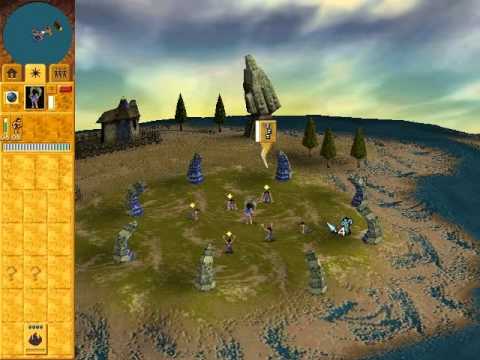
Each map starts out with your shaman and a handful of villagers around your incarnation circle. As is customary in RTS games your villagers can build buildings, gather resources, and fight things (but are not good at fighting). In Populous they can do all this and train to become warriors, priests, spies, or firewarriors but unlike every other RTS everything they do they do with gusto! Their animations are hilarious and this is the first part of what makes this game so great. If they are building something they actually run around building it, not just hitting the ground next to it, they are literally running around the structure hammering things, hauling things, and jumping up and down to raise / lower the land. If the shaman walks by they immediately fall on their faces in reverence. If you tell them to attack they start running and screaming as fast as they can and then punch, kick, push, pull hair, fall over, roll, get up, run inside a building and shake it all to pieces until it collapses... they're super fun to watch.

You'll use your starting villagers to build huts which will produce more villagers over time depending on how many huts you have. Villagers living in huts allow your shaman to recharge spells faster and also increase the speed at which new villagers are spawned. Extra non-house villagers can be used to grab map spells from magic nodding head statues or trigger a map changing spell from a totem. These are often valuable in your fight against the enemy as they usually contain spells that would otherwise be unavailable. Each map also holds at least one vault which bestows the permanent knowledge of a new spell or building unto your shaman that she can take with her to all future levels. The formula for going through a level is simple, grab the goods in the vault(s) then use said goods to your advantage and kill everyone who is not your color.
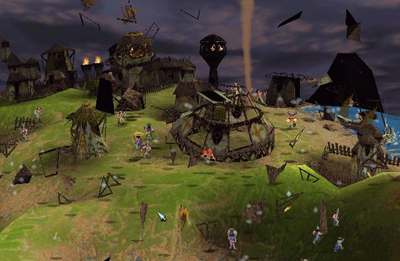
The star of the show is your shaman. With an arsenal of spells at her disposal she will eventually be able to level entire cities and send hundreds of enemies to their deaths in the blink of an eye. Her starting spell is the humble fireball which will send small groups of enemies flying, killing villagers it directly hits, starting the pants on fire of enemies that survive (they run around waving their arms and screaming trying to put their pants out). If you are particularly skilled with your shots you can use the physics to your advantage and control which direction the enemies get flung, preferably down a hill for greater damage or into water / lava which is an instant kill. The fact that little people will be sent flying (sometimes quite spectacularly) and then run around yelling and screaming in terror makes this game an absurd amount of fun. Lets just say I wasn't the only one who played the demo over and over, perching my shaman in a tower on top of the hill overlooking the red village and spent hours tormenting the enemy. "Oh look, you just finished repair that house..." wait for everyone to go back in, LIGHTNING STRIKE! House catches fire (again), villagers run out yelling and screaming with their pants on fire. "Oh look, you're sending your army up the hill to kill my shaman..." FIREBALL they all roll back down the hill, many of them die. SWARM SPELL the survivors scatter yelling and screaming before swarms of wasps. Eventually you will be able to call down tornadoes that comically suck the roof off buildings, then suck up everyone inside the building, erode spells that will send buildings and people into the sea, and volcano which creates a lava spewing mountain in the middle of someone's town in addition to many other goodies that are not named here.

Although very powerful your shaman is also quite vulnerable and your enemies also have one shaman each who will be gunning for yours. A stray lightning bolt, falling into water, or straying a little too close to the enemy armies will quickly see her dead. She comes back at the reincarnation circle after a little while but your mortal warriors will have to contend with the enemy in her absence and the enemy team who killed her will get a substantial boost in spell regen for a short time.


It's worth mentioning that every map is spherical. You can zoom out and spin the map to get a satellite view of the action. This may throw new players but I thought it was freaking awesome, especially back in 1997. Similar to Planetary Annihilation, a spherical map means that you can expand, attack, and be attacked from any direction. Most of the beginning levels (and a few multiplayer levels) restrict this because both you and your enemies do not yet have the ability to build boats or hot air balloons. Oh, did I forget to mention that your shaman can cast spells from a mobile hot air balloon? Even once these options are unlocked the strategic affects of the spherical map isn't as potent as PA's.
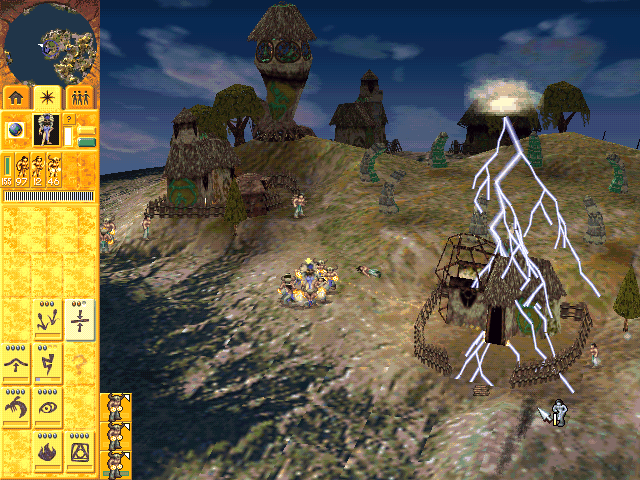


It's also worth talking about what sort of strategic value can be had with the few unit types available. Villagers can be trained into one of 4 other units by telling them to go train at the appropriate building (they line up to go in one at a time). Warriors are your tough melee hoard members. They will punch, kick, push, and pull the hair of enemies, ganging up on them 3 to 1 if numbers permit and make short work of all but other warriors in melee combat. Firewarriors are ranged combatants whose fireball spell isn't nearly as powerful as your shaman's, but if they all fire at once it will wreck havoc on enemy armies and quite possibly send some into orbit. These are best placed behind your warriors or stationed in a tower which greatly increases their range and firepower. Preachers, instead of fighting, will pull out a holy book and preach to the enemy. All who hear their voice (and are not already in combat) will sit down to listen and over time they will swap there pants colour to join you. If an enemy shaman or preacher goes up and slaps your preacher (for blasphemy?) everyone who was sitting down to listen to him jumps to their feet and beat him up. Spies will appear to be friendly villagers to enemy players who view them but will start their buildings on fire until caught.

The selection is small and simple. The focus really isn't on the units but on your shaman and sort of mayhem you can unleash but don't discount what your army can do. Your shaman can only do so much and even in the late game the enemy shaman or a small group of enemies that get too close can put an end to her. A large army though, not only is that tactically sound but hilarious to watch as they push over buildings, send enemies flying, and possibly lay a beat down on the enemy shaman for you. (An army of preachers is also very frightening, just saying). Add to this the fact that your shaman can make them invisible and immune to spells and they can become nearly unstoppable.

The game ending Armageddon spell sends every player and all of their people into an arena to have it out. Winner takes all.
The computer doesn't play very smart but it was pretty good for 1997 AI. They mostly just sit back and let you build up, sending their shaman and a small raiding party to your village every so often. A well placed lightning bolt or swamp spell usually stops them before they get anywhere close to your village. Later in the campaign they are a bit more aggressive and the map terrain has you at a disadvantage. It's enough to be challenging to casual and beginning players but intermediate RTS players will be underwhelmed. Thankfully the campaign mixes it up with a puzzle map every so often in which you must win by figuring out the solution, usually under an unforgiving timer, instead of by power.

As for multiplayer this game was a blast. Who doesn't love sending hoards of yelling and screaming cavemen to your friend's village and who doesn't love blasting said hoards off a cliff? Who doesn't enjoy a spell slighathon of lightning, dragons, earthquakes, and tornadoes tearing up the map? This is where strategy and experimentation with the physics engine can yield incredible and hilarious results, especially with terraforming spells like land bridge, flatten, volcano, and erosion.


Populous 3 is not a serious strategy game, but it is incredibly fun and very well put together. You play this game for the physics and for messing with the poor little AI villagers. If you can stomach the graphics (which were pretty awesome back in 1997) then the campaign is fun, if a little samey by the end. If you have a group of friends who are willing to go in with you then this is a blast to play multiplayer.


Now there is a light theological point that needs to be addressed. Populous includes blatant idol worship. The little cavemen will literally fall down on their faces to worship the magic nodding heads, totems, and the shaman. Now for anyone who has read through their Bible you know that idol worship and the pursuit of magic are anathema and were a major point of contention between ancient Israel and her God. Obviously Christians should not worship idols so how could I recommend a game that includes idol worship?

My answer is that this is a silly caricature of idol worship in general, nothing that encourages, endorses, or even resembles Old Testament Baal / Ashera / Molech worship.

Yaka! Let the games begin!

Friday, June 3, 2016

Greg Recommends Planetary Annihilation

Price : $29.99 or $39.99 with Titans Exansion

I was a little hesitant to put Planetary Annihilation on my Recommendation list. It was over-hyped in production as an Indie kick-starter success story that raised well beyond the stretch goals but turned out to be a different game than what the funding crowd had anticipated. The launch was plagued by bugs and Uber Entertainment's difficulty in communicating with the community / their questionable marketing practices. The game also had a some features that different review sites took issue with. For these reasons there have been a lot of negative and angry reviews on this game.

I still recommend it though as a fun and refreshingly different RTS, one that I thoroughly enjoyed playing and wish I had time to play more of. I've regrettably never played the Titans Expansion so everything here is for original PA.


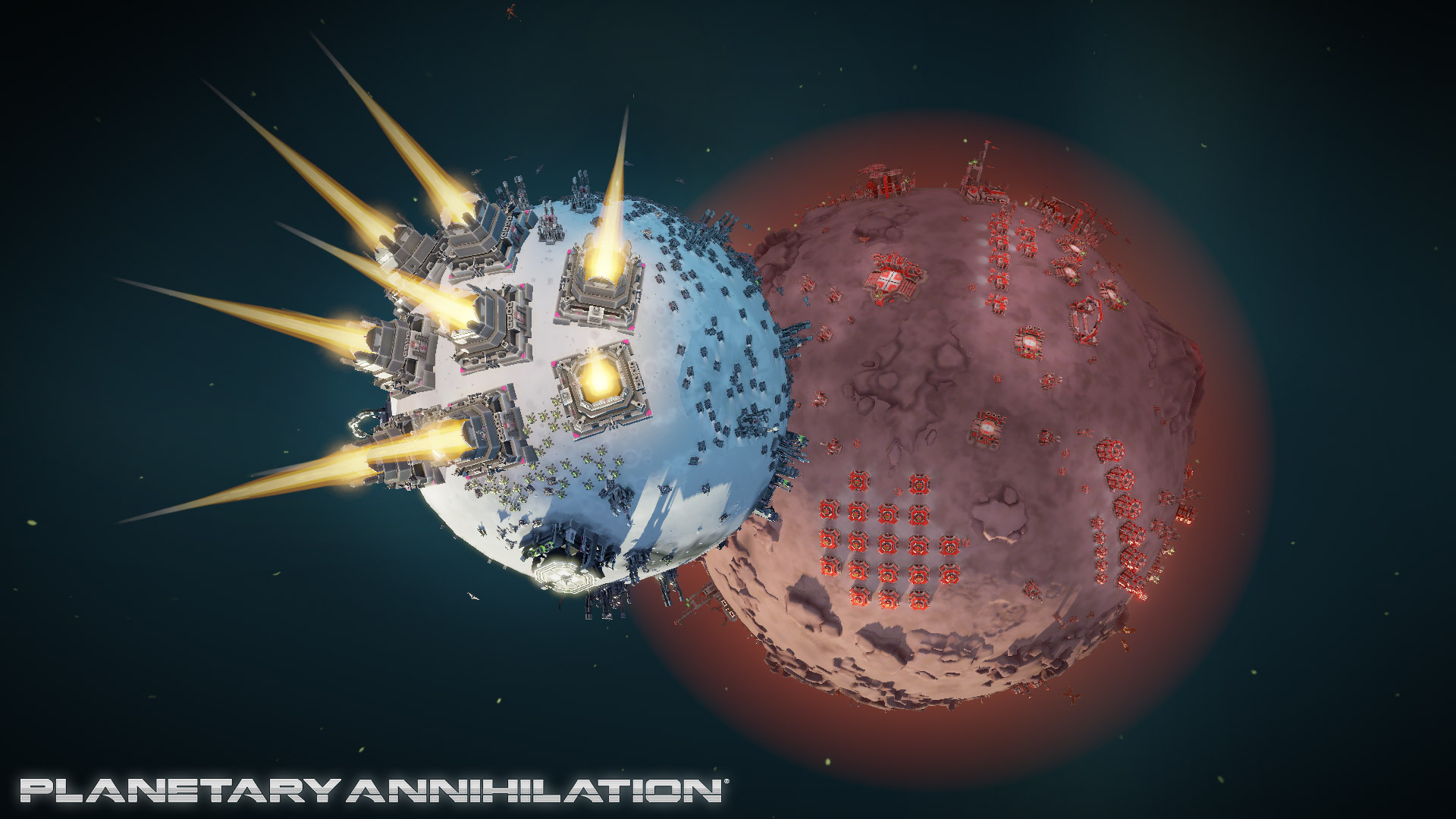
So PA is an innovative RTS whereby advanced robotic commanders are awakening all across the galaxy to wage endless war upon each other across the stars. Humanity is long gone, it's just the robots now, and there is no story line to play through except that all the other robot commanders are hostile so it's either you or them. If you kill the enemy commander then all of their stuff blows up. If your commander dies then all of your stuff blows up. Your objective? Kill the enemy commanders by any means necessary. How is this innovative? Spherical maps. Travel (and combat) in orbit around and in between said spherical maps. No unit cap. The ability to destroy entire spherical maps (and everything on / around them). There's also a full set of units with unique properties that give the game balance but every RTS worth playing has that. What makes PA's balance stand out is that creates what some enthusiasts have called a 'pure RTS'.


So let's talk about the spherical maps. In most cases RTS maps are flat with Planetary Annihilation being an exception. Flat maps allow you to see everything at a glance via a mini map that usually hangs out in a corner of the UI. Flat maps allow you to see all the possible routes you or your enemy could take towards each other and there is no confusion about which way is up. Spherical maps by contrast mean that you will never be able to see everything at a glance. Nobody can be cornered, enemy movements can be difficult to predict, and sneaky enemies can simply attack your base from a direction you weren't expecting. You can't see what you're units are doing half the time and said units could reach their destination and then be lost out of sight until you randomly spin the map and find them again. Uber added the option of using minimaps that could display the part of the planet that you were currently not focusing on but many gamers found spherical maps frustrating and thought that they should have just stayed an interesting concept and put forth arguments for why they take away from the game in practicality. I disagree. I love spherical maps. I love the ability to expand attack or be attacked from any direction at any time. I love the tactical options they provide. I love taking my enemies by surprise, hitting them from a direction they weren't expecting. I love how you get a huge advantage just by scouting your enemy to see where his troops / buildings are. Spherical maps aren't for everybody, but I loved them and maybe you will too.


The action isn't just on the surface of the planets, it is also taking place in orbit around them. If you zoom out far enough you go into 'orbit mode' which allows you to see the entire planet (or at least the side currently facing the screen) along with what is taking place in space around it. Your units and buildings become too small to identify and are replaced by minimalist icons that (once you get used to them) will easily distinguish what is what and allow you to command your forces without needing to go back down to the planet. Not only can you expand, attack, and be attacked in any direction, "any direction" also includes "up". Take care not to neglect the orbital game because a clever player may begin building orbital guns platforms above your base (I literally cackled with glee when I did this to another player for the first time) or build a mobile death laser satellite to snipe your commander out of the game. You can avoid this fate by building an interplanetary radar system (on the ground) early which will let you see what's going on in space as long as it has power. You can also build 'umbrella' turrets to shoot down orbital enemies or simply go into orbit yourself and create a fleet of spacecraft or construct your own orbital gun platforms.

This is strategy in three dimensions... or at least an outer spherical map around the smaller planet-side spherical map. But it doesn't stop there. Depending on the solar system there may be multiple planets, each a spherical map of its own that can be traveled to.


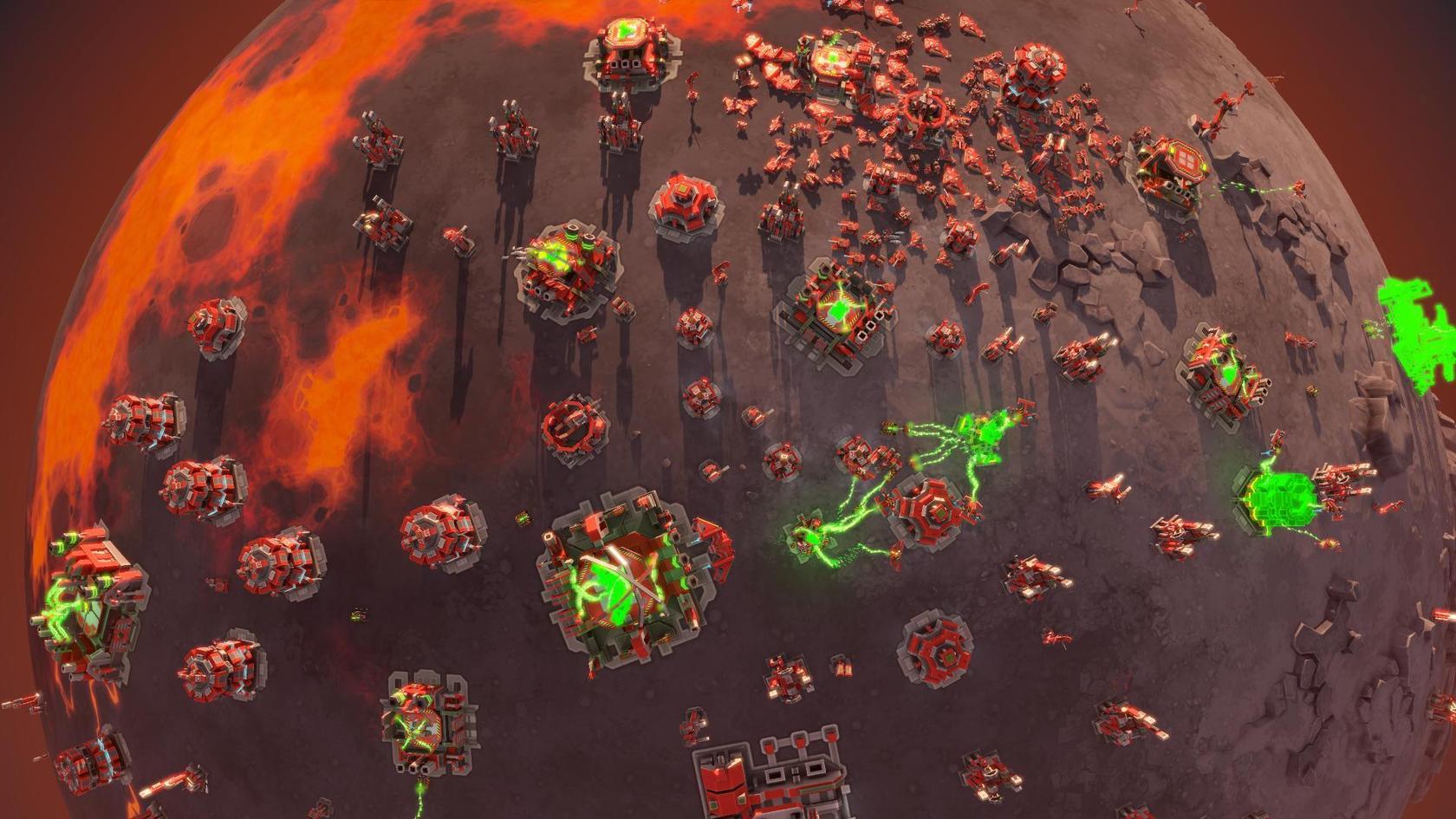
The level of destruction in Planetary Annihilation is unparalleled by any RTS title. With no unit cap you will be routinely commanding hundreds if not thousands of units at a time. Imagine that your opponent has an entire planet swarming with of bots, tanks, and aircraft. How would you attack that player? Well, to start a full scale planetary invasion all you need to do is build a gateway on the surface (which you can do from orbit) and start sending your forces through. Keep in mind that you only need to kill their commander and PA gives you a few options for how to do that when conventional forces aren't going to do the trick. There is the 'bombard them from orbit' option, but this can be countered by umbrella turrets and orbital defenses. There is the 'Planetary Canon' option which which you can literally shoot your army at a specific location on another planet. They do damage when landing and then more damage once they start shooting and three dozen advanced combat bots will make short work of a commander. Interplanetary nukes can end a game pretty quickly once deployed but they can be countered by anti-nuke missiles (assuming your opponent has them). If things are still not working out then it may be time to consider building thrusters on the moon so that you can SMASH THE MOON INTO THEIR BASE!!! (there is no defense against the moon smashing into your base) Or, if the solar system includes a metal planet, turn it into The Death Star and BLOW UP EVERY PLANET IN THE SOLAR SYSTEM!!! MWUHAHAHAHAHAHA!!!! All of this to an orchestral soundtrack and robotic affirmation noises that just sound so epic together.


So those are the innovative things that make PA unique. Now let's talk about what an actual game of PA typically looks like. Depending on the game settings your commander is either automatically deployed to a location on a planet or you get to choose your starting location manually. Auto-deployment ensures a mostly equal start for all players while manual deployment is a lot more... interesting. If everyone picks one planet while the last player picks another he will be able to expand and build up undeterred and will probably win the game. If you are unlucky enough to land right beside another commander then you may just die within the first minute of the game or have your start severely slowed down.

In any case, the first objective for new players is to start harvesting minerals and generating energy, the two resources of PA. Minerals are automatically harvested by mining stations built on mineral nodes scattered throughout the map (small green triangle icons). Energy is generated automatically by power generators that can be placed nearly anywhere. Your commander can quickly construct these.


The second objective is to start unit production through one of the four factory types, land vehicles, mechs, air, or water. Each of these factories can construct the basic units of their type in addition to fabricators that can build new buildings or speed up production of factories. Land vehicles are your tanks, flame throwers, and mobile anti-air. They are slower but pack a punch and have a lot of staying power for front line combat. Mechs are weaker but faster than land vehicles and are ideal for raiding. Air factories can build fighters and bombers which are very fast and pack a heavy punch but are expensive and have few hit points. Ships are expensive and slow but carry a lot of firepower and boast exceptionally long range (ideal for leveling coastal bases).

You'll build a few scouts and set them to auto-explore to find where your enemies are. If you're aggressive you'll send some bots to go mess up their resource nodes while using fabricators to claim your own. Depending on what your enemy is doing you may want to build some static defense turrets and you will definitely want to put up radars to let you know if any enemies are incoming.

The economy works on an income / depletion ratio. Units and buildings, whether you are building them or upkeeping them do not cost lump sum of resources (as opposed to StarCraft or Age of Empires) but deplete them over time. If you have resources incoming at a faster rate than they are being depleted then your stockpile gradually goes up. If you are spending resources faster than they are coming in then your stockpile starts to go down. If you run out of either minerals or energy all of your factories keep producing, just at a reduced rate. Radars (and I think turrets) go offline if there is no power left in your stockpile. The 'macro' of PA is to keep expanding your income and while also keeping up production to use all those resources to maximize efficiency.


Once you have secured your position it's time to pick a target and look for ways to kill their commander. Massing tanks is an easy and effective tactic, especially if your target is otherwise occupied fighting another player. If you can't see any way to quickly kill a commander then you need to assess whether it is better to go after his base, keep to raiding, or lie low to build up your forces.

If you can take out a commander or two with your early units then all the more power to you. If they prove difficult to remove then you may want to consider either going orbital or investing into advanced factories. Advanced factories can build advanced units (which are very expensive but exponentially better than standard units) and advanced fabricators which unlock all of the other advanced buildings. This is a true investment as your first advanced factory will take a long time to build and be a huge drain on your economy. The advanced units will greatly improve the effectiveness of your army though and the advanced fabricators can upgrade existing mining nodes and build advanced power generators to send your economy soaring. As for the advanced buildings, they include a variety of of defensive structures, heavy artillery that can shoot across half a planet, nuclear missile silos, anti-nuke silos, planetary canons, Hailey planetary thrusters, and catalysts that can turn metal planets into planet destroying Death Stars.

You always need to be assessing your enemy, trying to figure out his weak spot. Could you overrun him with tanks and just demolish his base? Does he have Anti-air? If not, then 25 bombers will kill his commander awfully quickly. Does he rely too much on air units? They die very quickly if countered. Does he have surveillance? If not then it would sure be frustrating and confusing for him to be attacked on two or three fronts at once. Are his power generators vulnerable? It would be a terrible shame if something where to happen to them... Does he have orbital? No? Time to build some orbital gun platforms over his base. Does he have anti-nukes yet? Is his commander susceptible to a swarm of suicidal boom bots? Remember, once you kill the commander, all of his units and all of his buildings are also destroyed and if you are clever you can put things in motion to kill a commander before the enemy can react to stop you.

Just remember that when a commander dies the blast will destroy everything within a large radius and you may want to pull half your army back when victory is assured.

If you are lucky enough to kick everyone else off your planet then you will have time to scout out the other players, identify their weaknesses, and then also have the sort of economic might to leverage them. Just don't neglect your own defenses, as your enemies can still snipe your commander whilst your are unaware...


Planetary Annihilation isn't perfect but it is innovative, unique, and put together well. I have a few personal caveats that I should put here though. Once your forces get beyond a hundred (as will often happen when there is no unit cap) it is difficult to manage such a large force beyond basic "everyone go this way and shoot all the things" type of instructions. Thankfully none of your units have deployable abilities except for your commander, so it's not a huge issue. Managing bases on two or three planets at once is a real hassle though. I think most players just manage a main base on one planet and then also a forward base on your chosen front of combat. Transport units (at least when I used them) are a real nightmare to use and may just get shot down while you fiddle with their finicky load and unload options.

The campaign is... lacking. You get a map of the galaxy and can travel from system to system. If the system is empty you get to unlock a new technology to take with you, if the system is occupied then you fight the AI using what technologies you have acquired so far to hopefully pick up another new technology. It was an interesting challenge at first to adapt strategies against the AI with a gibbled tech tree but got boring and samey half way through a medium sized galaxy. You can unlock additional commander skins by playing through the campaign but even though I've done half a dozen compaigns I've never had the opportunity to unlock said skins... either the planet required to conquer didn't spawn or it was owned by the wrong faction.

Personally I have had the most fun with playing 6 - 12 player free for all and the 1v1 competitive matches. Other players have really gotten into the alliance mode where you play with a friend to control your faction together. If I had any friends played this game then I would have been all over that.


Overall I think Planetary Annihilation is a fine game. It is a lean mean and streamlined RTS that 'cuts the fat' by getting back to doing the basics well and there's no point in being upset because its different than its predecessors. Anyone who poopoos it for not having more unit types / factions, for using spherical maps, or for Uber's marketing techniques either never understood what PA was before purchasing or felt entitled for some reason. Nobody forced people to purchase the beta for the full price of the finished game and nobody forced people to purchase additional cosmetic commander skins for an exorbitant price. If you're not happy with how much something costs then either wait for a sale or just don't buy it.

In any case I really enjoyed PA and if the user reviews on STEAM are any indication then Uber seems to have appeased their critics with the Titans expansion. I wish I could justify spending the time to play this game again.

Friday, May 27, 2016

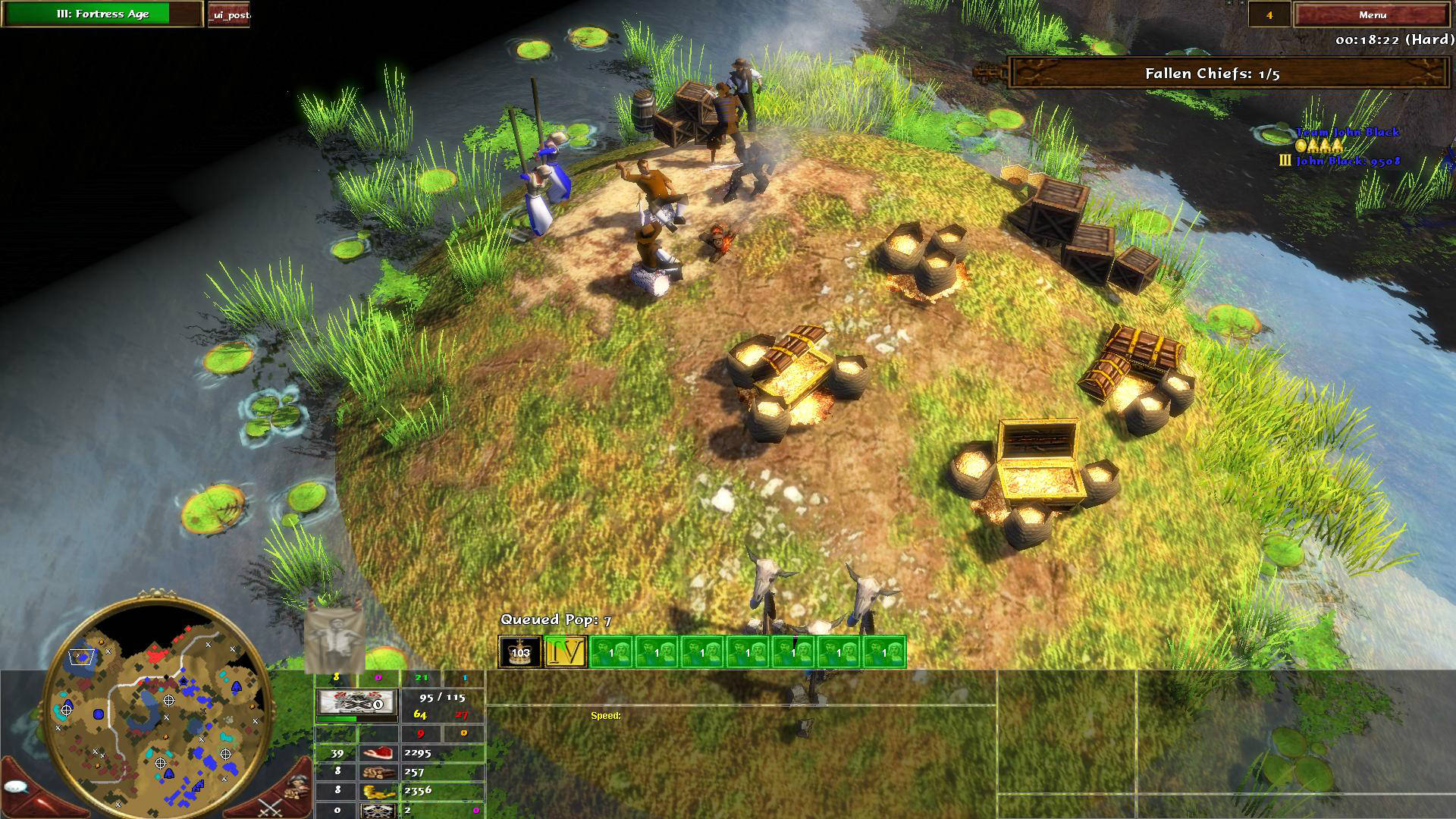
Greg Recommends Age of Empires III Complete


Price : $39.99

I grew up with Age of Empires and have played every game in the series to death. I remember standing in a long line in the cold to pick up a Boxing Day special for AoE3 at Future Shop and then spending more than what I saved taking my parents out for breakfast as bribery payment for getting me there at an ungodly hour and then waiting for the store to open. It provided me with years of quality entertainment so I think it was a good investment. I achieved the rank of Major (above average) in the online competitive ranking system but had to let it go when more important life issues came up and haven't been able to justify the time commitment to play competitively since.

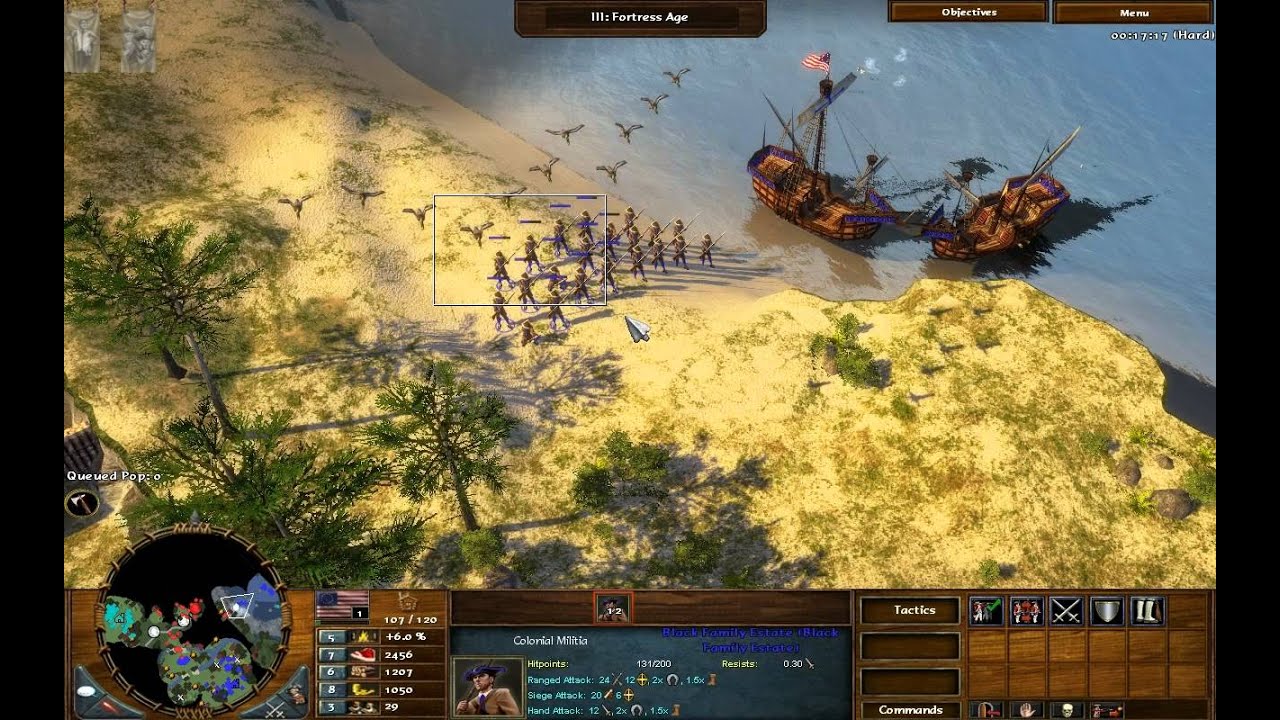
For those who have never heard of the series, Age of Empires 3 is a real time strategy game set within 1500 - 1800 in "The New World" (North / South America). The original AoE3 allows you to choose between 1 of 8 different civilizations while the War Chiefs expansion adds 3 more and the Asian Dynasties adds another 3. Each civilization has unique strengths and weaknesses that will greatly affect how you play the game but the basic gist of it is "gather resources from the map, build up a base to create military units and then use your military to burn down everyone else's bases and kill all their people." That is every RTS in a nutshell but Age of Empires 3 has a few things that make it stand out as an RTS title.


The first is an Age of Empires hallmark, being able to advance through the ages. An 'Age' in Age of Empires represents a significant advancement in history and technology. There are five ages (Discovery, Colonial, Fortress, Industrial, Imperial) Someone in the 'Colonial Age' can build basic military units and research basic upgrades while another player in the 'Fortress Age' will have everything from the Colonial Age plus advanced and specialized unites, new buildings, and better upgrades available to them. Each age builds upon and improves the units, buildings, and upgrades presented in the ages previous. Advancing to a new age is an expensive and time consuming move to make, and knowing when to make it is key to victory.

The second is a unique 'card' system whereby you can build a deck of shipments to send from your home city to your settlement in game. As you earn XP by exploring, building, and fighting you will earn the ability to send these shipments. The cards (shipments) in your deck can be anything from a squad of military units, extra villagers, unique technologies, extra resources, permanent unit buffs, or free buildings. There are different tiers of cards that correspond to the different ages; so a Colonial card can be sent once you reach the Colonial Age but a Fortress card can only be sent once you reach the Fortress Age. The higher the card tier the more potent / valuable the effects (usually). This ensures a wide variety of strategic options are available to you and so you can build as many decks as you have strategies to try out.


Here are some basic strategies to give you an idea how this works:

An aggressive 'hit them hard right from the start' strategy will rush to the Colonial Age and use military shipment cards combined with all the units you could build in the meantime to give you a formidable and quite possibly game winning force at the 5 minute mark at the expense of your economy.

A counter-strategy for this would be to send free guard tower buildings and crossbow units in addition to what you were able to build before your enemy attacks. (Crossbows are the early cost effective counter to building destroying spearmen)

Alternatively you could linger in the Discovery Age before advancing to build up your economy, send food and gold cards when you reach the Colonial Age, and jump straight into the Fortress Age to get elite military units and cannons while everyone else is still mucking about with spearmen and crossbows.

Your civilization bonuses, the map, and which civilization you're playing against are all factors to consider when deciding which strategy to implement. You can have as many decks as you like but you can only choose one to ship from when you claim your first shipment.


Age of Empires 3 features a strong "rock / paper / scissors / lizard / Spock" approach where everything is good against something else but can be countered by a different unit or strategy. Musketeers are a tough all-round balanced unit with a melee bonus when engaging cavalry but get torn to shreds by skirmishers and cannons. Skirmishers get a damage multiplier bonus against heavy infantry (muskets, spearmen) but will quickly fall to a hussar's saber or be blown away by a cannon ball. Cavalry will demolish artillery and light infantry but need to watch out for pikes, spears, and ranged cavalry which have significant damage multiplier bonuses against them. Add to that basic structure all of the unique units that come with which civilization you choose, the unique units that come with allying with indigenous peoples, and which cards you play / upgrades researched and you have yourself a very complex game of attack, counter attack, and counter-counter attack.

Knowing what counters what is essential when it comes time to engage your foe's military. "But isn't that all the time?" you may ask. No. Another key element of a good RTS is importance of raiding and harassing your enemies before going toe to toe with them directly. Killing enemy gatherers means they can't get as many resources which means they can't produce things as fast which means when it comes time to crush them they will not be able to resist you. Denying a gold mine or huntable animal herds early in the game will force your opponent to improvise or fold as you keep up the pressure and slowly strangle them for resources. Of course even here you have to be careful not to allow your enemy to kill your raiders or allow an opening into your own vulnerable economy.


Let's talk about maps for a minute. AoE3 features lots of map types which will generate a new random map every time the game is played. Typically players start out in the Discovery Age with a randomly placed Town Centre, a handful of villagers, and some starting resources with gather locations (huntable animals, berries, fish, gold deposits, trees) nearby. Depending on the map type some resources will be plentiful on the map while others are sparse. Some maps mix it up a bit by giving the player extra resources or a free economic building or free towers to start with. Maps possess all the usual obstacles and features you'd expect with cliffs, lakes, and forests placed randomly according to the map type and enemy players *usually* placed equidistant from each other on opposite sides of the map.

Where AoE3 mixes things up a bit is that there are treasures scattered throughout the map that your explorer can claim and specific locations along pre-determined trade routes and indigenous villages where you can build trade posts that net you new bonuses or abilities. The treasures can range from free resources to free units to permanent buffs for your explorer and can shave precious seconds and sometimes minutes off a strategy if collected. They are guarded though, so you will have to weigh the risk / reward ratio. Your explorer has a massive damage multiplier against treasure guardians and a 'snipe' ability that will kill a single treasure guardian in one shot but it has a long recharge time. Depending on your Civ and the cards you send you may be able to rack up a lot of treasures to give you an early game advantage. (Spain is a natural treasure collector)


The trade posts cost a heft 250 - 200 wood to build but if placed on a trade route will produce bursts of XP to speed up your shipments. Upgrading the trade route at any trade depot along that route (even if you are not the one to do the upgrade) will speed up the bursts of XP and allow you to get bursts of a chosen resource instead of XP. Placing a trade post at an indigenous village will allow you to train their warriors and unlock special technologies that would otherwise be unavailable to you. Some cards can be used to specifically enhance or get free indigenous units. Depending on the map you the indigenous units can be your key to an early victory! Even late game they can provide an edge over your opponent.


Here are some examples of popular maps:

Great Plains : A large wide open map with plenty of bison but few trees and scattered gold deposits. An ideal map for raiding. One long trade route that runs down one side of the map with Lakota and Comanche villages (melee and ranged mounted warriors with cavalry tech).

Yukon : A winter map split by a river with crossings on the top and bottom. On the right side are all the players with a trade route along the river and on the other side are valuable treasures, plentiful resources, and Cree and Nookta villages (powerful sniper and powerful building destroyer / cavalry killer)

Amazonia : A tropical map cut down the middle by a large river well stocked with fish with players taking positions on opposite sides. One side has a trade route with three nodes while the other side has three villages that could be Carib, Inca, or Zapotec. Claiming the river is essential for victory.


How does it compare to Blizzard's genre defining StarCraft 2? I would say that the RTS formula isn't as refined or as well packaged as SC2. Managing four resources (food, wood, gold, XP) at various points around the map as opposed to managing 2 resources that come gift-wrapped as part of natural base expansions means that you have more things to be aware of and divide your attention. There are a lot more options and possibilities in AoE3 (civ bonuses, cards, unique units, more techs, raiding) which, on the one hand give the game tactical and strategic breadth while on the other hand make it a bit unwieldy to play by comparison. AoE3 does not have the sort of 'micro' game that SC2 has. Your military units (with the exception of your explorer) do not have any special abilities, just raw attacks with varying damage multipliers according to who is attacking what. While 'micro' in SC2 is a professional skill in and of itself that can change the entire outcome of a game the 'micro' in AoE3 is still important but more simplistic and not quite as game changing.

SC2 hits the sweet spot between simplicity, depth, and what I'll call 'potency'. Three very unique and diverse factions (Terran, Zerg, Protoss) with 15-18 unique and diverse units each has been the foundation of a lean mean and powerful RTS engine that is currently driving International E-Sports. AoE3 is not as simple and its depth is in different locations. 13 different (but often overlapping) civs with dozens of units or variations of base units shared between them feels 'muddy' when compared to SC2's 'clarity.' The end result is that AoE3's RTS engine isn't as 'potent', as in, AoE3 struggled to become an E-Sport and has never really been mainstream while SC2 defines both E-Sports and mainstream gaming.

Personally, I love AoE3. I love all the choices, I love the overlap, and while the engine is older and isn't as refined or well packaged it still runs great.


The expansions (The War Chiefs + The Asian Dynasties) added a few things to original AoE3 to mix it up a bit. The three Native American civs added (Iroquois, Sioux, Aztec) are *very* different from the European civs from the original using a completely different building, units, and card set with 'big button' technologies that get stronger the longer you wait before using them, reusable cards, and dance circles that allow you to pick an buff (free XP, stronger units, everything trains faster, etc) and become more potent the more villagers go to dance there (up to 25). The Asian civilizations (China, Japan, India) are also suitably different from the European civs utilizing, another completely different building, units, and card set with wonders that give buffs while standing, and the ability to recruit powerful mercenaries by offering a small percentage of all items gathered in exchange.

Deck sizes were increased from 20 to 25 with adjustments made to existing civs to balance things out. Spies and Mercs can be hired from a saloon building instead of only being available through card shipments. Europeans Civs can declare independence instead of advancing to the Industrial Age which turns all of their villagers into colonial militia and they can build powerful colonial units and a powerful new colonial deck but can no longer gather resources. The new 'trade monopoly' victory condition and timed 'treaty mode' (no attacking for X minutes after start) were added.

The original game and expansions each have their own campaigns which are 'ok'. Definitely not the caliber of storytelling you'd get from a Blizzard title, but still alright. The original campaign recounts the connected story lines of a family of explorers and adventurers in The New World. I played through them all a few times and to be honest I only really remember about 5% of what happened beyond just blowing up the bad guys and feeling satisfied with that.


AoE3 is a solid and sometimes complex RTS with a lot of depth to explore. I don't know what the online community is like right now but it is still a $40 game so I suspect the community is alive and well. The game is great for LAN parties and has been integrated into STEAM which makes finding other players easier. If you're into RTS (or would like to be) then keep an eye out for this title.