Saturday, April 20, 2019

You Play WHAT?! - Part 2: The History and Controversies over Dungeons and Dragons

Originally written in 2016

Dungeons and Dragons, the infamous tool of Satan masquerading as an innocent board game that will introduce your children to the occult, consume their souls, possess them with demons, lead them to participate in satanic ritual abuse, and then make then commit suicide.

No punches held, this is what Dungeons and Dragons is famous for in parts of the Evangelical subconsciousness. This is the shadowy picture many a conservative Christian has grown up with (myself included) and even in some pockets outside of the Church DnD maintains a negative stigma as that strange game that kids lock themselves down in basements to play for hours on end. Is it really all fun and games or is there something sinister going on? My goal in this article is to explore and evaluate the history of and controversy surrounding Dungeons and Dragons.


First and foremost on the list of controversies to evaluate is Dungeons and Dragons' dark spiritual past. Does DnD introduce players to the occult? Is it associated with demons or Satanic Ritual Abuse? Are DnD players more likely to commit suicide?


A Brief History of Dungeons and Dragons

In order to answer this question satisfactorily we must take a long road and explore the history of Dungeons and Dragons and evidences associated with these dangers. The origins of Dungeons and Dragons had nothing to do with the occult, magic, demons, satanic ritual abuse, sex, or suicide. The creators; Gary Gygax, Dave Arneson, and Jeff Perren (TSR Hobbies) were inspired by the old Avalon Hill style war games in which players controlled different pieces on a board to simulate squads of WWI, WWII infantry, tanks, artillery, planes, and ships and a system of mathematics using probability (rolling dice) to determine simulated combat between these pieces. The first edition of Dungeons and Dragons (1974) was an alteration of these war games whereby players controlled one piece (their hero) and they worked together against enemy pieces (the monsters) which were controlled by the game leader and a similar system of mathematics using probability to determine simulated combat between these pieces.

The game received a lot of attention in 1979 when a young DnD player, James Dallas Egbert III, mysteriously vanished from his dormitory at Michigan State University. Nobody had ever heard of Dungeons and Dragons before and the private investigator speculated that it may have had something to do with the disappearance. The media grabbed a hold of this story and the board game suddenly morphed into a bizarre live action fantasy psychological game played in the tunnels of a boiler room where the players willed themselves to think and act like their characters to the point where they could not distinguish reality from unreality. Egbert was assumed to have been injured or murdered during a live action fantasy session that went wrong. This was later revealed to have not been the case, Egbert had severe depression and had attempted suicide in the steam tunnels under the school but failed and traveled about until contacting the investigator a year later. The media's reporting on the incident inspired the movies Mazes and Monsters (1982) and Skulduggery (1983) which solidified the urban legend that DnD put players into an altered state of consciousness so they could not distinguish reality from unreality and laid the foundation for the other urban legend that DnD was a tool of the devil to transform young minds to become serial killers.

Despite the rough media introduction (or maybe because of it) Dungeons and Dragons was a huge hit on college campuses and as time progressed TSR Hobbies created more material for Dungeons and Dragons including more character types, advanced rules involving more complicated mathematics, and more monster types. By 1979 'Advanced Dungeons and Dragons' was complete with a total of three core rule books and a handful of pre-made adventures as accessories. By 1982 DnD was selling 1200 copies a month and had found its way to computer games and popular media.

Then, in 1984, there was a tragic incident that sparked all of the Christian spiritual objections to Dungeons and Dragons. On June 9 Irving Pulling, a young man, committed suicide.

Irving enjoyed playing Dungeons and Dragons and his mother, Patricia Pulling, blamed the game for his death claiming that the other players had put a curse on him. She founded the anti-DnD advocacy group "Bothered About Dungeons and Dragons" (BADD) and began publishing all manner of accusatory material claiming the game was involved with Satanism, the occult, cannibalism, human sacrifice, demon possession, and other distinct forms of evil. Pulling considered herself an occultist expert and lead the charge against what she perceived to be rampant underground Satanism in America. Parallel to this movement ran the anti-Satanic Ritual Abuse advocates who had already planted the belief in conservative Christian culture that the aforementioned rampant underground Satanism existed in America with their own writing campaign and put a lot of people on high alert creating the perfect environment for BADD's accusations to gain traction.

Pulling published dozens of stories about how people playing Dungeons and Dragons became possessed by demons, kidnapped and murdered children, participated in orgies, sorcery, idol worship, and every other Old Testament sin that would horrify modern sensibilities and bring down the thunder from conservative pulpits. The legend was born, Dungeons and Dragons was not just a board game, it was a Satanic tool of spiritual destruction and moral decay and the story was taken up by self proclaimed cult investigators, and conservative Christian groups like Chick Publishers and the National Coalition of Television Violence (NCTV).

By 1990 BADD's credibility along with the credibility of the anti-Satanic Ritual Abuse movement were being questioned, critiqued, and found destitute. Pulling and her following were publicly exposed in the Stackpole - Pulling Report for grossly misinterpreting and making up facts, using unreliable and illegal investigative and publishing methods, taking advantage of mentally unstable 'witnesses,' and being completely uninformed about even the most basic elements of a real Dungeons and Dragons gaming session. The American Association of Suicidology, the U.S. Centers for Disease Control and Prevention, Health and Welfare Canada, and other such institutions had unanimously concluded that there was no causal link between fantasy role playing games and suicide. As further scrutiny and investigation was applied to Pulling and her allies their credibility collapsed like a house of cards never to be rebuilt but the wild and incredible stories lived on in the hearts and minds of many conservatives.

TSR continued to publish a host of material including a third edition of the game, extra source books, miniatures, and video games. Aside from some failed lawsuits against sthem they remained largely unaffected by the moral panic of the 80s except for deciding to change the names of some of the monsters (demons and devils) and then making a resurgence into popular culture shortly thereafter.

CHIC Publications, published William Schnoebelem's "Straight Talk on Dungeons and Dragons" in an attempt to champion the dying cause. CHIC's warcry was answered in 1995 by Jeff Freeman's "Concerns that Christians should have about Dungeons and Dragons" which, aside from laying out arguments in favor of Christians playing Dungeons and Dragons, criticized Schnoebelem's article for being based on ignorance and misinformation and for outright lying to everyone. Freeman's rebuttal was answered by Schneobelem in 2001 with another CHIC publication "Should a Christian Play Dungeons and Dragons" which is currently the definitive article in support of BADD's claims.

Like other conspiracy theories everything published by BADD its allies and the anti-SRA movement is questionable at best. It does not hold up against basic fact finding and the psychological methods they employed to get confessions (hypnosis for example) have long since been debunked.

Even so, the questions still remain. Is DnD associated with the Occult? Are players at risk of being manipulated by demons? Has it ever been associated with actual Satanic Ritual Abuse? Are players at more risk of committing suicide?

The problem with going forward from here is that nearly all evidence in favor of these accusations is anecdotal and can not be connected to real life persons or happenings. How much anecdotal evidence has its roots in BADD's anti-DnD publishing campaign? "Nearly all of it" may be a realistic assessment. BADD made as big a splash as it could and now the water is still murky twenty six years later.

Even though BADD and SRA proved to be a farce I can not completely throw out anecdotal evidence regarding demon possessions and other similar encounters involving Dungeons and Dragons. As an Evangelical Christian I believe in the Bible and I believe in the existence of spiritual beings. I have also had personal encounters with the demonic and have performed two exorcisms on different occasions (anyone who hopes to do one of these is either specifically gifted or has never done one before). My convictions and my experience tell me that the occult, demons, abuse, and motivations toward suicide are all real issues. I want to take these accusations and evaluate them as fairly and objectively as I am able.


Sorcery and the Occult in Dungeons and Dragons

Does DnD teach the Occult? No. All of the source books for every edition of Dungeons and Dragons ever produced are available for download online. If you were to read through every single one of these books cover to cover you would not learn any authentic sorcery or occult practices. At no point has any creator, author, or publisher for Dungeons and Dragons ever tried to sneak teaching the Occult, sorcery, or Satanism into the game material. How could they? They were nerds not warlocks. Schnoebelem claims that the game makers came to him in the 80s (when he was a warlock) to make their rituals as authentic as possible, but he doesn't give any references and nobody has been able to find what rituals he was referring to. If there were authentic occult teachings or rituals in any version of DnD then it would have been spotted by now and the proponents of this accusation (Schnoebelem especially) could point to a physical book and page cross referenced with an actual book of the occult but this has never been done.

This perceived danger comes from two sources. First and foremost it comes from BADD's baseless assertions popularized by Chick Publishing's Dark Dungeons tract. Secondly it comes from a misunderstanding of High Fantasy. High Fantasy is a fictional setting inspired by ancient mythologies and modern classics such as J.R.R. Tolkien's The Lord of the Rings. There are heroes and villains, knights and monsters, dragons, and demons, and devils, and demigods. There are wizards, sorcerers, druids, and eastern mystic monks. All of these things (save for heroes and maybe knights) are expressly forbidden in the Bible and all of these things are 100% fiction in Dungeons and Dragons, ie: not real. The players are not literally casting spells at each other, they are rolling dice and doing complex math. Playing a sorcerer in DnD teaches as much sorcery as playing Axis and Allies teaches you how to kill with a Lee-Enfield MK III rifle or how to drive a Panzer IV.

Darkest Dungeons - CHIC Tract
Could players become tempted to pursue the Occult or sorcery? Sure I guess. Exposure to High Fantasy (like Science Fiction) broadens your mind and introduces you to a host of new ideas and concepts, that's one of the reasons why its so fun. Small children and Christians who are ungrounded in their faith may be at risk of being swayed this way or that way as the wind blows and so may be tempted to attempt actual real life sorcery but in my experience the individual who goes to pursue magic already had a fascination and exposure to it long before playing Dungeons and Dragons. The inoculation against this is very simple; don't mistake the fiction of a game to be reality. In addition to this be grounded in your faith, know the Scriptures, teach your children wisdom. If you find out that the people you are playing with are actually trying to use Dungeons and Dragons as a vehicle for teaching real magic (BADD's greatest accusation and something so extremely unlikely that I can barely conceive of it happening) then stop playing with them, warn players that were unaware, and document the incident because you will have just found the proverbial needle in a haystack.


Demonic and Dungeons and Dragons

Are DnD players at risk of having demonic activity in their lives? No, provided the players don't do anything to provoke demonic activity while playing Dungeons and Dragons. This is a topic that I take seriously. Playing Dungeons and Dragons as it is intended to be played does not involve anything that should encourage demonic activity. Getting carried away with your role playing in Dungeons and Dragons to the point where you are physically and verbally involved in such activity goes well beyond the material of the game. Avoiding this should be obvious to the point where nobody should even have to mention how. Don't use Dungeons and Dragons as an medium to call upon or attempt to summon actual real life demons. Nowhere anywhere at any time is this encouraged or mentioned or are players given even vague instructions for how to do this in any of the DnD source material ever created.

There are monsters in Dungeons and Dragons that are called 'demons' but they are not at all related to actual fallen angels rebelling with Lucifer against The Lord God Almighty. The 'demon' monsters in DnD are, like all monsters in DnD, quite literally a collection of statistics for players to roll dice against. What the statistics represent, if you are role playing as a character, are a series of hostile physical creatures who come from one of several 'hells' which in High Fantasy are different planes of existence. At their worst they are basically the Balrog from Lord of the Rings, which Gandalf referred to as "an ancient demon of the underworld;" a big scary monster made of fire that you should probably run away from. Biblical demons are quite different by comparison and no real parallel or likeness can be maintained between them except to say that they are both evil creatures and share the name of 'demon.' (See below for what a Dungeons and Dragons 'demon' actually looks like)


There are also 'spells' in Dungeons and Dragons that allow players to 'summon' monsters to come fight for them, some of the monsters summoned can be the aforementioned 'demons'. Just as DnD 'demons' bare no resemblance to actual real life demons so too do summoning spells bear no resemblance to actual occult rituals used to summon actual real life demons. All spells in Dungeons and Dragons, like all monsters in Dungeons and Dragons, are quite literally rows of statistics used by players to mathematically determine the success or failure of what their imaginary characters are attempting to do. Here is a picture of the summoning spell in question.


Suicide and Dungeons and Dragons

Suicide, the incident that sparked moral outcry against Dungeons and Dragons in the first place. The concern here is that those who play Dungeons and Dragons can get too attached to their characters or enter into a non-reality to the point where if their character dies in game the player will be unable to cope with the loss and be driven to commit suicide. The history here is once again BADD's assertions that this was an issue which then become popularized by Chick Publishers' Dark Dungeons Track. Is this an actual issue? No. Has it ever actually happened? Weldon and Bjornstad's Playing with Fire: Dungeons and Dragons claims that it has at least once or twice. I have not personally done the research to verify the validity of these claims except to say that the American Association of Suicidology, the U.S. Centers for Disease Control and Prevention, and Health and Welfare Canada (and dozens of societies and universities since) had done the research for us and unanimously concluded that there was no causal link between fantasy role playing games and suicide. It is widely understood that Irving Pulling's suicide was not due to over attachment or involvement in Dungeons and Dragons or because any curse that was supposedly put upon him. Both he and James Egbert struggled with depression which was not widely understood at the times of their deaths.

This is a strange myth. Any sane person will overcome the loss of their fictional character, create a new character, and maybe be inspired to write stories, poems, or songs of their fictional deeds. Anyone who has trouble coming to grips with such a loss was either already dealing with some heavy issues in their life or was otherwise mentally unstable. It is worth mentioning that at the time when this accusation was first made suicide was not understood or talked about in society, especially in conservative Evangelical circles, and so Dungeons and Dragons became an easy scapegoat.

The reality is quite the opposite, playing Dungeons and Dragons (and other fantasy role playing games) reduces the risk of suicide. It is a psychologically provable fact that role playing games like Dungeons and Dragons are healthy for those who are under stress or in the midst of depression. It gives a temporary escape away from the stress and depression into a world where they are the hero and they are able to laugh and play with friends. It gets them out of the negative head space long enough to regain a more objective view on life and stop the cycle of depression that leads to suicide. This was one of the reasons why young college students like Egbert and Pulling were drawn to Dungeons and Dragons in the first place and why I lead my own DnD campaign, inviting the players that I did.


Dungeons and Dragons as an Introduction to Pornography

This is not an argument that I have actually heard before but it is one that I have. Our North American culture sexualizes everything and High Fantasy is no exception. The official Dungeons and Dragons material is pretty tame but if you ever look online for images related to Dungeons and Dragons or High Fantasy (for character concepts, inspiration, or building your own DnD session) some searches will yield user generated blends of High Fantasy and sexual fantasy. For a mature ('strong') Christian that can filter what their eyes see this may not be an issue but for young men and women with young sex drives ('weak') this is a potential gateway towards porn addition. For safer browsing (though not completely safe) try http://char-portraits.tumblr.com/ (female characters)


Dungeons and Dragons and other Bad Influences

Dungeons and Dragons sessions take on the flavor of the players involved. The activities of the characters, the stories, the jokes, and the general table banter are all determined by who's sitting around the table. Who you spend time with will affect you after a while. Take an evening and read the Book of Proverbs and then do as it says; don't keep company with fools and then apply the lesson to who you play DnD with.


Playing Dungeons and Dragons is not Compatible with Christian Faith

William Schnoebelen
This is the criticism championed by William Schnoebelem in his two Chick Publications "Straight Talk on Dungeons and Dragons (1992)" and "Should a Christian play Dungeons and Dragons? (2001)" (go ahead and give him a read, his arguments epitomize the views in 90's conservative Evangicalism for why a Christian should not play Dungeons and Dragons) Even though I disagree with Schnoebelem and find elements of his story extremely unlikely I respect the Christian tradition he represents. His second article is far better than the first and wrestling through this material for years refined my own thinking and position on the issue. When you strip away his references to BADD's baseless assertions (nearly everything in the first article) he is accusing Dungeons and Dragons of 1) a slippery slope where anyone playing, even with the very best of intentions, will inevitably end up participating in immoral activity that is forbidden in Scripture and 2) the game acting as a medium for anti-Christian ideas.

His primary concern has to do with the role of the mind and imagination. He argues that it is openly sinful to think about many of the activities that DnD characters do. His argument plays out like this. If you play a rogue for example, your character may stab someone in the back or steal from an NPC. Stabbing in the back and stealing are sinful acts. You the player had to conceive of them in your mind before your character could do them. BAM! The game got you to use your mind to conceive of acts contrary to the rules and statutes of God as laid out in the Holy Bible. You could have used your mind to worship God and bring him glory, instead you created new ways to sin and are now fantasizing about that sinful activity and gleefully sharing it with the other players. As if that wasn't bad enough it's only a matter of time before you start acting like your character and begin stealing in real life!

I object to this reasoning on several counts. First and foremost I object to Schnoebelem's understanding of sins of the mind as such reasoning is nowhere found in the Bible (see this list of verses that have to do with thought and the mind). We are instructed to set our minds upon what is good and godly (Col 3.1-2; Phil 4:8), allow the Holy Spirit to transform our minds, not conforming to the ways of the world (Rom 12:1-2), and to not allow our thoughts to lead us to sinful activity (Jam 1:14-15; Rom 6:12; 7:23-25). The only time where the Bible address thoughts as sinful in and of themselves is Jesus' teaching concerning lustful thoughts (Mat 5:28) and this is precisely where CHIC and Schnoebelem attempts to make a non sequitur connection between lustful thoughts and role playing games.

One of the verses that Schnoebelem uses is 2 Corinthians 10:3-6 which he applies to Dungeons and Dragons as a medium for ideas that are in opposition to the knowledge of God.

"For though we walk in the flesh, we are not waging war according to the flesh. For the weapons of our warfare are not of the flesh but have divine power to destroy strongholds. We destroy arguments and every lofty opinion raised against the knowledge of God, and take every thought captive to obey Christ, being ready to punish every disobedience, when your obedience is complete." (2 Corinthians 10:3-6)

My response to this is that the ideas and worldviews in Dungeons and Dragons; the stabbing things in the back, stealing, fictional magic, monsters, pantheon of gods, moral alignment system, and anything and everything Schnoebelem takes issue with only become 'lofty ideas raised against the knowledge of God,' if you let them by taking them seriously; that is to say, become unable to discern fictitious play from reality, as if understanding and playing with a worldview different from your own somehow nullified it. Schnoebelem would probably argue back that it can and does happen subconsciously regardless of our division of fiction and reality and that we should not "give the Devil a foothold" in our minds. I would argue that playing Dungeons and Dragons does not "give the Devil a foothold" and maintain that the division of fantasy and reality is the key. The human mind / spirit is capable of this first of all as a natural ability bestowed by God from creation as a provable psychological fact, secondly as indicative of our being created in the image of God, and third as part of the regenerative work of the Holy Spirit. According to the Bible we have not been given a spirit of fear but of power, love, and self-control (2 Tim 1:7), and we can take thoughts captive instead of being captive to them (1 Cor 10:5).

My second objection to Schnoebelem's article is his overemphasis of the power of Satan and that the freedom believers have in Christ did not enter into his equation. Christians of all stripes have incredible freedom in Christ to say as Paul did "All things are lawful for me but I will not be dominated by anything." (1 Cor 6:12; see also 10:23-31). This freedom is to be used responsibly to the glory of God and is in part determined by the believers' conscience as well as the consciences of the other believers around them. Paul uses the dichotomy of the weak and the strong where 'strong' believers are allowed to eat food sacrificed to idols because they know that the food is just food and that idols are just lumps of rock, whereas the 'weak' believer would stumble in his faith because he believes that the food has been defiled and that the idols have demonic power. The 'strong' should live in his strength eating and drinking to the glory of God but should restrain himself for the sake of the 'weak' who may see him indulging and falter in his faith. (Rom 14; 1 Cor 10:23-31).

Christians have often used this understanding for how to handle 'gray issues' (like the use of alcohol for example) and I would apply it to Dungeons and Dragons as well. There's nothing wrong with Dungeons and Dragons; it is, as much as Schnoebelem denies it, just a game. I am coming at this from a position of 'strength' but for other believers who understand Dungeons and Dragons from a position of 'weakness' it would not be good for them to play because their conscience objects to something within the game as sinful. The 'strong' does no wrong for playing Dungeons and Dragons unless it is done in such a way to cause the 'weak' to stumble and the 'weak' does no wrong in avoiding Dungeons and Dragons as a matter of conscience so long as this avoidance doesn't attempt to force the 'strong' believer to obey the precepts their weak faith.

My third objection to Schnoebelem's position is his overemphasis on the importance of the mind and the need to censor it. He claims that the mind is the battlefield upon which the destiny of the soul is decided. I disagree and would argue that the battle was won over 2000 years ago by Jesus' death and resurrection and that the Word of God is not nearly as impeded by people playing make belief in a High Fantasy setting as he claims it is. I disagree with the whole fundamentalist movement to censor 'unchristian' ideas and establishing a Christendom thought control system lest uncontrolled ideas lead Christians astray from Christ or non-Christians to not find Christ. It never worked in the past and has a tendency to backfire, producing ill-equipped Christians, bitter Christians, and even more bitter Christian apostates. Christians should be established in their faith, grounded in the Scriptures, but not isolated from other ideas. There is a time to shelter young or new Christians for their benefit and growth but taken too far or for too long it becomes a stagnation and impediment to their faith. Nonbelievers are already in the world and of the world, it is futile to try and shelter them from it. What does it say about our faith if we are afraid of being exposed to other ideas? Is the Word of God so fragile or so incomprehensible that we must censor imaginative play? No! The Word of God is living and strong, and God is an excellent communicator. There is no need to scare people away from games that involve High Fantasy settings. If there was a need then forget Dungeons and Dragons and look instead to the rampant greed, lust, violence, and 'anti-Christian' worldviews currently presented in less abstract mediums; DnD is very tame by comparison to today's TV shows, movies, and video games.

My fourth objection to Schnoebelem's position is that if you take it to its logical conclusion then Christians must abstain from thinking about pretty much everything that is not God and the Bible. Dungeons and Dragons is out, video games are out, television shows are out, books that are not the Bible are out, serving as a police officer, doctor, or actor are out, nearly every type of music is out, martial arts are out, and don't even get me started on thinking about dating or your spouse! Schnoebelem's position on Dungeons and Dragons is one of impassioned fear and weakness that probably comes from his horrible experiences as one of the highest ranking practitioners of Satanism and the Occult in North America in the 80s. This is not a position that other Christians should live under though. We are adopted sons and daughters of the king of the universe in whose image we have been created as the masters of creation. Yes the human spirit was dealt a deforming blow by the curse of sin but God has shed his own blood to redeem us and now dwells within us by his Holy Spirit so now we can once again live as we were intended and not be blown this way or that way according to the winds of opinion or be taken captive by lofty ideas or allow sinful passions to persist in our minds. We can read books without mistaking ourselves or our motivations for those of the characters in those books, we can become professional actors and not damage our Christian identity, we can become doctors and not be carried away by lustful thoughts at the sight of exposed genitalia, we can be exposed to and explore the ideas and planes of high fantasy without being confused concerning the knowledge of God and we can play Dungeons and Dragons without sin. Christianity does not slink about hiding in the shadows afraid to think lest we get lost in our thoughts or become confused about God or demons take notice and swoop down to assault us.

Be certain though that you are sure of the knowledge of God; you must get your understanding from theologically reliable sources and maintain a strong life of faith cultivated by constant prayer and spiritual discipline. The freedom we have in Christ is freedom in the context of loving God with all our heart, strength, and mind. This is a matter of priorities and maturity. Keep Christ first in your life and heart and keep Dungeons and Dragons (as well as every other hobby / pastime) in its proper place in relation to Christ's lordship. Don't do as Schnoebelem fears, getting your knowledge of God and the world from High Fantasy fiction, stay with the Bible, go to a good church for constant teaching, community, and spiritual care, don't be conformed to the world but be renewed in your mind by feeding from the Word of God.

My fifth objection is the tone Schnoebelem and CHIC take on the issue. Any disagreement with their statements is taken out of context or used as evidence of game addiction, being anti-Christian, being in the pocket of the gaming industry, or some other reason for why a 'true Christian' will just ignore that argument and side with the publisher. This is the weakness of the combative conservative far right, a complete refusal to discuss the topic or admit when they have been wrong. Case and point Schnoebelem's critique of Freeman's assessment of Pulling's (and his) "fortress mentality."

Freeman reveals his true colors. He is against Biblical Christianity:
"Ultimately Pat Pulling had only one allegation remaining that anyone would listen to - and even then only fundamentalist Christian groups were willing to believe it. Fantasy role playing games, they asserted, were occult indoctrination tools that lured white suburban teens into horrific satanic cults. Furthermore, these cults were everywhere. The popular "fortress mentality" of certain religious groups - the belief that the world is a wholly corrupt, evil place that only their faith protects them from - latched onto this "evidence" of Satan's power. Proof that the world was in Satan's grasp could be found by demonizing every aspect of pop-culture."

Biblical Christianity does not have this "fortress mentality" that Freeman points out. Yes we believe that Christianity is the only true religion, yes we believe that the world is fallen, but not wholly corrupt in the way that Freeman is talking about. Schnoebelem and CHIC latch on to anything and everything they can with which to smear their opponents but so many of these rhetorical attacks fall flat. They also refuse to acknowledge when they have made a mistake and continue to fight in favor of assertions that are simply not true (DnD teaches magic, DnD causes suicide, etc). Their tone and technique in dealing with disagreement is unsavory and unethical by a worldly standard and contemptible by the very biblical standard they claim to uphold. Given their track record all of their assertions should be put into question.

A sixth objection I have is that Schnoebelem seems confused about his own worldview using strong Christian language in such a way that I wonder if he isn't still operating in a Pagan worldview. He posits that someone who plays DnD could accidentally trigger a 'spiritual rule' and unintentionally fire off a curse or summon a demon similar to how one could accidentally pull the trigger of a loaded gun. I suspect his experience as high priest in the Church of Satan (among his other occult titles and experiences) may account for this concern. My conviction is that 'spiritual rules' which Schnoebelem claims are like loaded guns do not exist. The devil does not get to stake claim to any number of colors or patterns or words and an innocent person who accidentally mimics what a practitioner of the occult does is not in danger of running afoul a spiritual landmine. God knows the heart and the devil and all the demons need his permission before acting so the danger is in the intention of the action, and not the action itself (unless the action is inherently hazardous). Just because Buddhist monks use Mandelas in their meditation practices doesn't mean that a Christian could accidentally find herself emptying her mind and experiencing 'one with the universe' if she looked at a Mandela for too long. No God created all things and Christ redeems all things, there is no danger of accidentally pulling a spiritual trigger.

The final objection I have isn't so much with Schnoebelem's article as it is with his questionable background. Schnoebelem makes a number of claims that seem suspect but taken all together he is a former Wiccan Sorcerer, a former 2nd degree member of the Satanic Church, a former 90th degree Free Mason, a former vampire, had sex with a demon, had more demons in him per cubic centimeter than the entire city of Indianapolis, and he was also a former 1st degree member of the Illuminati. He repented and became a fundamentalist Christian and is now running a circuit ministry to combat The Occult, Mormonism, Free Masonry, Satanism, The New World Order and UFOs for Jesus. Schnoebelem's biography is incredible, there is no mistaking that, even more incredible than what he claims DnD is and is responsible for. I haven't done the research into his past to say that he's a fraud... but the biography he holds to and the ministry he profits from look and sound similar to the sort of hoaxes that Joseph Smith, L. Ron Hubbard, Marjoe Gortner, and a number of other charismatic circuit riders pulled during their lives and so I approach his claims with skepticism.

All in all Schnoebelem blows Dungeons and Dragons out of proportion. It is, as much as he objects, just a game and a pretty innocent game at that. He is still worth reading though as his challenges are (hopefully) made with the spiritual well being of the reader at heart and, at the very least, he asks a lot of soul searching questions that should be wrestled through. He warns us to be on guard against opposing ideas about God that will subvert a proper understanding if you passively accept them. Don't confuse fantasy for reality and make sure that your understanding of God is grounded in Scripture and not what you pick up from the world around you.

You play WHAT?! - Part 1: Discovering Dungeons and Dragons as a Christian

Originally written in 2016


"You play Dungeons and Dragons!?" my new friend stared in shock. I have had this kind of reaction before and knew I would have some explaining to do.

"Um... yes?" I cautiously responded.

"Isn't Dungeons and Dragons evil?" he asked in astonishment...


It's ingrained within the more conservative strains of Christianity (my context being Evangelical) that Dungeons and Dragons (and games like it) is somehow associated with sex, sorcery, and suicide. A while ago I created a longish and perhaps unwieldy explanation of how Dungeons and Dragons does not do any of the outrageous and evil things it has been accused of. This is my attempt at a more coherent explanation of a Christian's perspective on Dungeons and Dragons geared specifically for Christian friends or parents concerned about someone playing DnD as well as Christians who are intrigued by the game despite been told that it will wreck their life.

Part 1 - Discovering Dungeons and Dragons as a Christian


I was raised in a conservative Christian home. My parents took their roles seriously and focused on building as strong a family unit as they could. We loved each other. We valued good hard work. We went to church on Sundays, volunteered in church programs, and went to kids clubs and youth group. My parents took precautions to filter out violent and destructive elements in my formative years by way of limiting what we watched on TV, which kids I was allowed to hang out with, and which social functions I could attend. In addition to this they took precaution against our being exposed to magic, the occult, and demonic influence as good Bible believing parents should. They weren't raving fundamentalists, but they took the Bible, as well as their spiritual role as parents seriously and insulated me and my siblings against influences that could lead us away from Christ. While this sometimes lead to situations where I didn't get to do what I wanted growing up I loved them for what they did and still do. We had good open and honest conversations and they always had good reasons for every rule. Maybe your background is similar, maybe it isn't, the point is that I come from a conservative Christian background where the Bible and personal faith were and still are foundational to who we are.

My father and grandfather used to play Dungeons and Dragons a long time ago and still sometimes played role playing games on the computer like Might and Magic (back in the late 80s - early 90s) and I enjoyed looking over their old maps and notes and collections of dice. I learned to enjoy fantasy at an early age and I enjoyed thinking about the heroic knights, evil monsters, castles, magical swords, flying carpets, and trap laden caves that I saw my father and grandfather exploring on computer. My imagination was exposed early and it left an indelible mark.

At first my father and I bonded over the experience, I distinctly remember jumping around the basement in celebration when we finally defeated "the cyclops king" and his "bubble brain" minions in the Might and Magic 3 computer game (1991). I remember the sense of awe and wonder when he explained the powerful fireball magic that the magic character could use only once and how it could backfire if he got it wrong. I remember my grandfather getting far ahead of dad and how he fought ghouls and dragons and other things dad and I had not encountered yet (on a colour monitor too!). I remember my grandfather reminiscing about how he and dad and my uncle used to play Dungeons and Dragons, how one of them would be the referee / dungeon master and draw the map while the others tried to find their way out. It seemed to my little mind that this was the height of entertainment and adventure!

I suspect my parents saw my growing enthusiasm and decided to stop feeding the fire. I remember how they would sit me down on different occasions to explain that Dungeons and Dragons (and things like it) were dangerous and something I should not become interested in. Some people who played that game got too attached to their characters and then killed themselves if their characters died, some became possessed by demons, and others started attacking each other with actual weapons because they couldn't separate the game from reality. Understand that this was all pre-internet so my parents' couldn't fact check and that these were the sorts of stories that made it into the news back then, my parents were going with what information was available at the time (see part 2 for a history of the hysteria over Dungeons and Dragons). It became clear in my young mind that Dungeons and Dragons had a dark side and that I ought to avoid the game like my spiritual destiny depended on it. Strangely enough dad's old maps and DnD-like games vanished shortly thereafter, but Grandpa still reminisced on occasion.

I continued on through school with a love of fantasy being fed instead by C.S. Lewis' Chronicles of Narnia, Robert Jordan's Wheel of Time series, and J.R.R. Tolkien's The Hobbit and The Lord of the Rings. I loved fantasy, it spoke to me in ways that other forms of fiction did not. When I wrote stories, they were fantasy stories, and when I drew pictures, it was almost always some creature or place that didn't exist in our world but may exist in Narnia or one of the worlds I imagined. Every once and a I while I would get a chance to play RPGs on the computer like Baldur's Gate and Neverwinter Knights which were placed in a fantasy world full of incredible stories, characters, monsters, and an epic struggle between good and evil. (I found out later that these games were quite literally Dungeons and Dragons in video game form.) There were a few times when my brother and I attempted creating our own board game that mimicked the computerized DnD (that we didn't know was DnD) and my father would be in his glory explaining the probability of dice rolls and how to scale statistics according to level (he was a math and computer science teacher after all), but we stayed far away from real DnD because it had become taboo.

Then I moved away to college at Briercrest where I learned theology, biblical studies, some psychology, and higher critical thinking skills. I had heard that there was a secretive group that played Dungeons and Dragons on campus, but I did not seek them out. I was intrigued, but decided to keep to my studies and look into the Christian DnD group later.

Then, during the summer of my third year at college I decided that I needed to learn more about this forbidden fruit that continued to smell sweet to me. I approached it slowly at a distance with my guard up as though I were approaching a real dragon. I started by reading John Weldon and James Bjornstad's Playing with Fire: Dungeons and Dragons, Tunnels and Trolls, Swords and Sorcery and other Fantasy Games. I even wrote a review on the book afterwards. This Christian tome identifies the dangers of Dungeons and Dragons to exist in 1) an abuse of fantasy 2) an abuse of escapism 3) playing in a world of nonChristian morality and 4) how the line can become blurred between a player and his character. After re-reading the book, the Stackpoll Pulling Report, the anti-DnD literature from Chic publishers, a variety of blogs and websites, as well as spending a long time thinking and praying about it I came to the conclusion that it was actually safe for me to take another step forward. I had no intention of mixing fantasy with the occult, I was grounded well enough in the Word of God to not get sucked into escapism or living in a non-reality, and, from what I understood of the game, if I was the one leading it then I was the one to determine the morals of the game world.

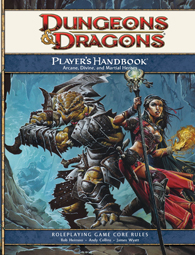
I purchased a 4th edition player's handbook along with two packs of Dungeon Master dice and set to work creating a small adventure for my siblings to go on (after getting permission from mom and dad of course). There was far more math and stats and prep work to go through than I thought there would be and most of the experience was crunching numbers and preparing the map for hours before playing. I built a dungeon for them to escape from complete with patrolling monsters, traps, and bits of a story line that I might continue if they enjoyed the experience. We played a few times and had lots of fun learning how it all worked. It was like interactive story telling where each person would take turns narrating what their character was doing. My father even joined in and we had a blast. No lure of the occult, no demonic influence, no questionable morality, just lots of good natured fun... at least that's what it seemed to be on the outside... on the inside... nah, just kidding, it was good natured fun all the way through.


A lot of the mystery and mysticism surrounding Dungeons and Dragons was dispelled after I actually played it and got a handle for how the game worked. At its core the game is make belief for adults ideally played with five people, four of which play as characters in the story with the fifth person (the Dungeon Master) telling the story and describing what the characters see, feel, and experience. When one of the characters tries to do something that has a chance of failure (climbing a tree, shooting a goblin, convincing an angry cyclops to not squish you because you are actually his long lost brother that has been turned into a human, etc) you roll some dice and do some math based on your character's statistics to see if you succeed or fail. Then the story goes on.

The monsters and magic that have been demonized by various groups in the past are just tables of statistics to be used when rolling dice to determine whether a character is successful or not. When sneaking past an orc for instance, a character must roll stealth higher than the orc's listen roll. If the character is using magical boots, he gets a bonus to his roll.

Not once did I or any one of my players ever have a creepy encounter with the demonic or feel the pull of the occult or act immorally or indecently or do or experience any of the things Dungeons and Dragons has been condemned for.

By the time I hit seminary there were two secret Dungeons and Dragons groups on campus and I was leading one of them and was a prominent player in the other one. When DnD night came my house was packed with friends and the campaign which started with 3 people grew to 9! We had a blast, everyone got to enjoy themselves, and after the games people talked and got caught up. We lived in a busy college campus out in the middle of the Saskatchewan wilderness where there was no drinking allowed and academics were taken very seriously. The escapism provided by DnD night was a welcome break where nobody had to work on papers and we could just relax, pretend to be someone else for a few hours, and take out some frustration on fictional monsters. For anyone who thinks we should have taken a hard line approach of all study and no play I congratulate them for thinking they have the mental fortitude for such labour but will argue strongly that nobody else there did and that fun, frivolity, and fellowship are a foundational piece to being human as God intended. People opened up afterwards about their struggles in life and it allowed us to keep tabs on one friend who was borderline suicidal and a few more who were wavering towards that line. It also opened up excellent conversations about faith and spiritual health... probably because we were all Christian college students studying the Scriptures every day, but that's beside the point. Dungeons and Dragons started out as just a fun game between friends and it became a safe place for the people on the fringe to feel welcome and start opening up. The friendships forged and the lessons learned were invaluable and I sincerely believe that God used the game night for his glory. Did Dungeons and Dragons replace or distract from devotions or prayer or Bible study? Absolutely not. It gave us a break so we could process what we learned and allowed us to see life from different perspectives (an important part of higher and personal learning). Playing DnD safely as a Christian is not only possible but in the right context it can become a ministry for those who just don't feel like they fit in.

Now that I am done school I still keep in contact with a few of my players and my players keep in contact with each other. I don't get to play much of anything right now because my time is spent working and taking care of my young family. I'm slowly chipping away on other campaigns to maybe play in the future but that is another post for another time... Occasionally I get a random message from one of my players to say they still remembered the campaign and and we get to reminisce about adventures and friends.

So that has been my journey with Dungeons and Dragons in a nutshell: from fear to fun with a slow steady and traceable pace in between. My parents came along for the ride with me in some respects. I don't blame them for shielding me from what many perceived as a threat at the time, because knowing what I know now I still would have shielded myself. They were being responsible parents and weren't afraid to make uncomfortable decisions according to their faith. I respect and love them for that. Now about why so many people thought Dungeons and Dragons was a danger there is lots I would like to say on the topic. Part 2 of this series is going to tackle that.

Friday, October 13, 2017

Greg Recommends City Skylines


As of the writing of this article (October 2017) Paradox Interactive's "City Skylines" is the best city builder on the market. It's basically Sim City except bigger and better in all the ways that matter. It's a relaxing "go at your own pace" ginormous sandbox of opportunity that layers a multitude of systems on top of each other to create a city building experience that keeps it simple enough for beginners but with enough depth and mechanics to keep the expert city builders occupied for hundreds of hours.

Image from the Steam Community

Anyone who has played a Sim City game will immediately be familiar with the 'zoning' system whereby you designate what types of buildings can be built in different parts of your city. You start out every city by laying road down off a preexisting highway into whatever layout you like and then designate different zones (residential, commercial, and industrial to start). Virtual citizens will then start flocking to your tiny town and start building houses and businesses for themselves. The amount of each type of building as well as their location relative to each other matters. Residents will need jobs to work at and shops to frequent and the various industrial and commercial businesses will require workers to run. You need to keep a balance so that your city can keep growing. Keep on eye on the RCI panel to see what type of buildings are needed.

As mayor you're responsible for providing your citizens with basic utilities and so you'll also start off by laying down some water pipes underground and then connect them to a clean source of water for drinking and somewhere else (hopefully down river) to dump your water waste. (Don't worry, you'll eventually unlock more environmentally friendly ways to dispose of your raw sewage). You'll also need to provide electricity via a power plant (cost effective but makes lots of pollution) or wind turbines (expensive but eco-friendly). More options are unlocked later.

As your town grows you'll begin to reach population milestones that unlock more features for you to play with. You'll be 'plopping' down schools, parks, police stations, fire stations, clinics, and public transport buildings that will increase the value of your land so the buildings on it will upgrade themselves while also preventing danger and injury to your little people.

All of this is pretty standard and almost a direct copy and paste job from previous Sim City games. Where City Skylines surpasses Sim City in the basics is in its pathing logic, customization, and logical infrastructure. In Skylines your little people actually live and work in specific buildings while in Sim City your sims take the first vacant building / working spot they can find on their commute to and from work. In Skylines the traffic has always made sense while in Sim City the traffic only kind of makes sense after years of patching to try and fix what was originally a nightmare. In Skylines the relationship between residential / commercial / industry matter, you need to have a good balance to thrive while in Sim City your sims will be happy to live in a city with no stores, no schools, and no jobs.

A traffic solution I build myself!
As your town grows and becomes a city you'll run into problems with traffic. This is normal as the types of roads you had access to at the start weren't designed to accommodate the vast amounts of people who now want to live in your community. The question (and the fun) in this game is 'what are you going to do about it?' How are you going to fix the traffic problems?

Skylines gives you some powerful options for dealing with traffic. You can increase the number of lanes, you can make a road one-way only, you can build ramps and tunnels, but most importantly, you can place roads pretty much however you need to without the game telling you 'you can't do that' or auto-snapping your roads to where it 'thinks' they should go (like a certain other city builder series). There also options for mass-transit (buses, trains, ferries, metro, etc). You can even place or remove individual stop lights and stop signs at specific intersections if you want to really micro-manage traffic flow throughout your city and it will make a huge difference when you do.

Here's a story from my own city. At the entrance at the edge of the map I had a super busy four way intersection. North connected to the highway. South went into the downtown. East went to my farms. West went to my lumber industry. Everyone coming in and going out had to compete with heavy freight traffic wanting to go east, west, and north. Everyone had to stop at the lights and there was always a lineup on all four sides. At first I replaced the four - way with a roundabout so there would be no stoplights. This worked for a while but the traffic didn't flow as nicely as I wanted it to and lineups still happened. I did some brain storming and thought about real life overpasses and then tried to build one myself. It took a little trial and error but I eventually did it, I built my own overpass so now the traffic flows smoothly from every direction, no more stopping, no more slowing, it was a very satisfying feeling when I had finally gotten it to work.


As your city keeps growing it will become beneficial for you to separate it into different sectors. This is easily done from the HUD and costs you nothing to do. Sectors are areas of your city that follow specific rules that affect what your little people can and can not do, how much they pay, and how much they produce. You may want to put pollution restrictions on an industrial zone but also give them permission to double their production by cutting corners on safety. You may want to make an especially high value part of your city pay higher taxes and restrict pets and freight trucks to keep it as desirable as possible. I was especially pleased with the sector option that made large commercial buildings double their sales which ended up doubling my income per month in taxes even for my small city.

Sectors also allow you to customize what specialization your industry will have in that area. Farming (if on fertile ground), forestry, mining, and oil are all options that will produce needed goods for your city as well as a lot of freight traffic to import and export needed materials. It is usually worth thinking through how you will keep your freight traffic smoothly going where it needs to go and away from your busy commuter routes.

You'll also need to set up a garbage disposal system, a 'death care' system, public transport, put down more schools, and experiment with new zoning types (high density residential / commercial and offices). If you have the 'Night Life' DLC then you'll also be wanting to look at the entertainment industry to bring in tourists and the potential for lots of crime.


Underneath the hood of this game there is a lot going on. Your city actually has specific needs that your little people will try to fill. Businesses require workers of varying education levels as well as specific materials to function. Your stores need specific freight of varying types which can be produced by your industries or imported. Your industries require specific materials to make their products. Home and business owners will expand if all their needs are being met so even more people can live and work there. Your little people will drive, bike, walk, and jump between all manner of public transportation to get to work, go to school, go shopping, and go home. Each of these things affects your city and Skylines provides lots of tools to track these analytics. You can see at a glance how effective each of your systems is, and which areas of your city are being overlooked.

As you keep growing things keep changing and the old systems and infrastructure that used to work fine will need to be upgraded, changed, or removed and replaced with something else. The result is an organic city building experience that moves at the pace you set for yourself.

After a while you will start rubbing up against the sides of your portion of the map. That's ok, you're allowed to buy more sections. You can even download a mod that lets you use the entire 5x5 grid to build a massive metropolis provided your CPU can handle it.

Two bus routes and two metro routes combine at the center of town to take everyone where they need to go.
The fun in this game is definitely in the building, the problem solving, and the watching. Planning out how I want my little people to meet their needs and move about smoothly is fun and the Skylines has enough options and more than enough depth to make the planning phase a stimulating endeavor. The robust mechanics ensure that there will always be things to do and problems to solve as well as a multitude of ways to solve them. This game respects you and gives you free reign to use all the tools a real city planner would have and lets you make mistakes so you can learn from them.

The game is also beautiful. It may not be as polished as Sim City (Maxis loved to polish all their stuff) but it still looks great. I sometimes lose track of what I wanted to do just looking at the busy streets and all the traffic flowing like life giving blood through the arteries of a living thing.

screenshot from Jonathan Bolding's review on The Escapist Magazine

It gets better though. The game is fully supported for mods which means the community has put together a very large body of easily added buildings, vehicles, people, utilities, and much much more to grace your city. Simply visit the City Skylines Steam Workshop and start subscribing to whatever content you would like to have access to for free.

The only things I can say that could use improvement in Skylines would be if they had in-game tutorials, campaign or, challenge maps. There are plenty of tutorials online, which are good, and you can download player-made challenge maps, but these tend to be unrealistic.

The game is a bit expensive if you're purchasing the base and all the DLCs at regular price. As is common with Paradox games the base game is always being added to with free features as new DLC is being created while the DLCs themselves still really add a lot to the base and it is worth picking them up if you enjoy the game. Here is a list of the current DLCs and what they do.

After Dark - Adds 'Leisure Specialization' which makes your commercial buildings extra active at night and 'Tourism Specialization' which makes your commercial buildings near the beach a hotbed for tourism.

Snowfall - Adds the option to have a winter city with snow removal being another system to layer on top of your city. Unfortunately there are no changing seasons (yet).

Natural Disasters - Adds the ability to afflict your city with a variety of natural disasters.

Mass Transit - Adds a variety of new mass transit options to get your citizens from point A to point B without clogging your roads.

Green Cities - Adds a bunch of specializations, buildings, vehicles, parks, policies, and scenarios of the eco-friendly variety.

Concerts - Adds the ability to get live performances in your stadium(s) to generate money, traffic problems, and maybe crime.

Cosmetic Packs - There are a variety of packs that add extra buildings from the top of the modding community.


On a final note perfectionists may need to just relax and mentally prepare before playing this game. It is entirely possible to build a perfect city with a perfect grid and a perfect balance of all types of buildings and services. however, I would advice against this and I think that it is far more interesting and freeing to not try and build a perfect grid. Allow yourself to make things unsymmetrical and even (dare I say it) mistakes on purpose. Let your city have some personality. If you try for the perfect grid every time then you'll be frustrated as you run into new options you hadn't considered when you first started building.

City Skylines - Easy to get into, difficult to master, organic, vibrant, deep, mod and community friendly, this is the best city builder in a long time.

Saturday, July 1, 2017

Greg Recommends The Anno Series

UBISoft / STEAM / GoG
Dirt Cheap to $50 depending on the title.


The "Anno Series" are real time strategy games that blend city building with business and resource management. The first title, Anno 1602 launched in 1998 and the most recent title, Anno 2205 launched late 2015. Each of these titles is good and you can start with any one of them.

1601 - Tobacco Plantations. Good graphics for 1998.

Your goal in each of these games is to go out and locate a new home to settle, build up, and 'conquer'. I put conquer in quotations because the game is 98% settling, building, and perfecting. These are peaceful and often slow strategy games with a heavy emphasis on building placement and resource management over and above combat.

1503 - An army lies siege to your city! Graphics upgraded from 1602.


One of the core mechanics behind the series is that your citizens will require (demand?) certain things according to how fancy their house is, similar to the old Caesar classics but far easier to control. So taking the first game, 1602, when you create a new house the residents require that they live within a certain distance from the town center building and that your island inventory contain enough food to feed them. If you don't meet these basic demands the people will eventually leave and the building will collapse over time. Alternatively should you go above and beyond the basic requirements and provide some of their requests like being a certain distance from a chapel and have access to wool cloth, they will be happy to pay higher taxes and even improve their residence should the appropriate resources be available to them. These upgraded houses represent an entirely new class of resident with the former demands and requests now becoming the baseline to maintain them and a new list of requests being presented. So now instead of pioneers requiring community, a chapel, cloth, and fish you now have settlers who require all these things but now also request alcohol, spices, education, and tobacco. The higher the tier of housing, the more people live therein, the more money you can tax, but the more they require to stay happy.

1701 - Zooming in close to one of your ships. Large graphics upgrade from 1503.


As the population of your settlement(s) grow you gain access to new buildings that you need to keep growing or just make your existing infrastructure more efficient. To ensure that you branch out from your original island home no one island will have everything that you need to keep growing. Once you are established on your home you will find yourself loading up a ship in hopes of finding more new land, hopefully containing the right conditions to grow your own grapes or spices or whatever it is that your people need before they upgrade their houses again.

1701 - A lively port city!


The result is a game of mostly peaceful building with ships sailing this way and that delivering goods back and forth as you slowly add more layers of complexity to keep up with the needs of your people before meeting the map's win conditions. Later titles after 1602 add a few interesting twists like different types of resources, expanded diplomacy with other players, lesser NPC nations that hold exclusive luxury goods, tech trees, going underwater, additional society factions, or landing on the moon, but the core premise and game-play fixtures are always the same.

1404 - Everything is somehow bigger and crisper than 1701.

The graphics are always good for the time in which the game was released. Anno 1602 graphics were quite good for 1998 and Anno 2205 has great graphics for a 2015 game (read: beefy video card and processor required), but I have always found the details limited. Everything looks good, but it all starts to look the same after a little while. If you've seen one block of housing you've seen every block of housing and your cities tend to feature lots of blocks of housing. You can zoom in to see your people milling about in the newer titles but your people do little more than just mill about. This isn't like Tropico where every person is busy doing things on the island, the 'people' you see in Anno are just eye-candy and while the buildings and the countrysides look beautiful they are just representative of the real game of supply and demand and expanding your infrastructure to make your city bigger. I think that, in a strange way, the beauty of the game works against itself in that people expect to find a higher level of detail and personality in the graphics of a game that looks so good.

2070 - Welcome to the future. Everything is much bigger here.


One thing I have always appreciated about the Anno series is the music. Orchestral and dynamic right from good old 1602 onward. Many of the songs are downright gorgeous and make the game a joy to play. Here's a link to some good music from 2070 to show you what I'm talking about.


As for the combat it is minimal and the least interesting part of the Anno series. Should your expansion for more resources get blocked or if you're just greedy or a jerk then you build warships of varying sizes to go sink your rival's boats and blow up their coastal buildings. In the pre-2070 titles you can also build a handful of soldier types to land on your rival's island and take it over one warehouse at a time while the new titles employ airborne drones with which to bomb things. The defense against ships, soldiers, and drones is to build static defense towers to shoot at enemies within range in addition to having your own ships, soldiers, and drones. There is no strategy beyond 'attack as a big group' and taking out an opponent is a long and boring task.

2070 - An underwater base. Very important for producing algae, oil, and many rare elements.


The fun of this game is definitely in building a big city and setting up the supporting infrastructure. Whether that's lumber camps and clay pits in Anno 1602 or Oil Rigs / Processing plants and mass produced fast food in Anno 2070. Some of the production chains to get desired items can be quite involved; like creating service bots in 2070 which requires sand from a river, copper from a mine, corn from a farm, seaweed from an underwater farm, a chip factory, a biopolymer factory, and a robot factory. Getting the balance of lower tier resource gathering buildings to higher tier refining buildings mixed with the ever growing demands of your population can be a daunting task after a while, but this is part of the fun.

2205 - You thought things in 2070 were big? This is REALLY big.


There is also fun in just sitting back and watching a well oiled infrastructure servicing a city. All those ships coming and going and, depending on which title you're playing, either delivery people carrying wheelbarrows of goods this way and that or airborne drones ferrying cargo all over the skies.

The Anno series is about long term gaming. You can't really just play through it in a week and be done, completing a map takes a long time and there are lots of maps to play through should you desire them.

There is multiplayer, although I have never tried it outside of building peacefully with my family in 1602.

2205 - Building on the moon.


The one caveat I have on this series is that the DRM on Anno 2070 was so stringent that I couldn't actually play my legally purchased version of the game for years and their customer service team eventually just threw up their hands and said "we don't know how to help you." I eventually found the answer in a steam forum about which setting was off in my network that made the game impossible to play.

Other than that I think the games hold a lot of merit. They make infrastructure fun, they look and sound fantastic, and they are primarily a peaceful building game which we probably need more of in our violence obsessed culture.

Thursday, January 26, 2017

Greg Recommends Sunless Sea


Price : $18.99

The Sunless Sea is a stand alone game in the same universe as the Fallen London browser game. The year is sometime during the reign of the Empress Victoria, London was stolen by bats and now rests a mile under the surface on the shores of the Unterzee, that strange, dark, and ancient subterranean ocean full of mystery, adventure, and horror. You play as a Zee Captain in a setting that goes from refreshingly odd to unsettling to horror filled and back again as you explore the environments and narratives Failbetter Games lovingly crafted for you. The mood at zee is similar to Fallen London, dark, haunted, mysterious, Lovecraftian, and some dark dry humor. Instead of exploring and interacting with a handful of districts within Fallen London you have the entire unterzee and all of its ports of call to zail and explore. A word of caution though, death is a very constant (and often brutal) companion. This is what you might call a narrative / environment driven rogue-like exploration game. There is combat but you would be well advised to avoid it until later in the game. You make progress by exploring and advancing story arcs and the zee itself will prove a most formidable adversary even if you do manage to avoid the denizens who want to take a piece out of your ship.

The general formula of a voyage is presented thusly:

Every voyage begins at Fallen London. You'll spend 'echoes' (currency) to purchase food, fuel, crew members, upgrades, goods to sell elsewhere and other such things. You'll also check with your contacts in London to see if there are any story arcs or missions available should you perchance happen to be zailing in that direction or stumble upon interesting things in your adventures.

You pull out to zee way from the warm lights of the fallen city into the perpetual darkness of the unterzee with only the occasional beacon and the light of your rusty old zeeship to dispel the gloom. As you explore the unknown it will be recorded on your zee chart (world map) and for every island, reef, settlement, and strange thing you find you gain fragments (experience) which will enable you to level up and increase your captain's base stats. The unterzee is mysterious and unpredictable and so the islands rearrange themselves every play-through. Scattered about the islands you will find locations to land and interact with whoever (or whatever) is of interest there. You'll often be presented with story arcs and challenges similar to Fallen London (the browser game). You are given the odds of success as calculated according to your stats with something good happening if you succeed and something 'less good' happening if you fail. Depending on the nature of the challenge 'less good' may be anything from receiving a lesser reward to dying a horrible non-reloadable death. Typically though failure is rewarding and often gives you the chance to try again without consequence thus encouraging you to attempt challenges even if your chance of success is low. Between chance encounters and pre-defined story arcs and missions you can rack up a fair bit of experience and the potential for a lot of echoes by pursuing these island activities. I say 'potential' for a lot of echoes because most of the treasures you uncover really only have value if you survive long enough to turn them in / sell them back in Fallen London.


The game has a lot to do with choices where the consequences aren't obvious but are nonetheless foreboding. The almost dead 'Tomb Colonists' invite you to a feast and they look to be extremely hungry, do you go with them or decline? A wistful demoness wants to purchase your soul, do you sell it to her? The criminal underground wants you to pick up and bring back a package for them and will have "something sharp to say" if you return empty handed but will pay very well if you can smuggle it in, do you accept this job? The first few times I played I was very conservative and tried not to take too many risks. Then I began to understand the game in terms of exploration and narrative and I realized that the riskier choices were almost always more fun (and rewarding) even if I did fail.

The real danger, the thing that keeps killing me in this game, is not knowing when to turn back. You can stock up on food and fuel in other places than just Fallen London but it will be costly if it can be done at all. Should you run out of fuel you will either have to find something else to burn (food?) or you will be at the mercy of the Imperial Laws of Salvage (you lose your ship, crew, and cargo in exchange for a 1hp rustbucket with enough fuel and food to hopefully get you back home). Managing fuel and food is pretty easy though, its the sanity that can catch you off guard. That's right, sanity. As you float about in the deep dark cavern with the deep dark unterzee below you and God know's what below the surface or on the ceiling your crew starts to get a little afraid. Keeping your ship near shore and in the light halts their loss of sanity but you will not gain any back unless you're willing to pay for shore leave or return to Fallen London. Once your sanity reaches a critical level strange and terrible things begin happening. "The crewman stood near the edge of the ship and a large pale tentacle noiselessly pulls her overboard. You rush to the side but she is gone. Nobody seems to have seen or heard anything. You didn't... you didn't push her... did you?"


But here's the thing. The potential for reward and adventure get larger the further from London you zail. If you turn back too soon you may not make enough echoes to restock your ship, but if you keep going... This can quite easily turn into "just a little bit further... I have to see what is on that island" or "but if I can just fill in that piece of the zee map..." The rewards and adventure are greater, but if you don't turn back at the right time you may not get back at all.

Once you go out as far as you dare you have to make it back home. If you are low on supplies or sanity then you are especially vulnerable and the the shortest course back home may not be the safest.

Assuming you make it home though, limping into harbour with a half mad half starving crew and a cargo hold full of treasures, it's time to cash in, restock, and upgrade. The Admiralty Board pays you for every 'port report' you bring back to them (a reliable source of income and especially helpful for new captains), and fulfilling quests for your contacts also yields a good influx of echoes. Random events may allow you to sell your findings from the unterzee at a higher price than usual and the Black Market will often finance voyages if you agree to do their bidding.

Make enough voyages and you may earn enough echoes to buy yourself a decent house, a new ship, start a family, locate better contacts, and write a will to give your next captain a better start when you either retire or die at zee.

There are other, more subtle, creeping threats that can become a problem if you're not careful. Your sanity may be largely restored every time you return to London but if it had gone too low you will begin suffering from nightmares, and nightmares in a Lovecraftian environment are never a good thing. If you start associating with shady types (as most successful zee captains often do) then the authorities will start to take notice and should they suspect you of treason then searches to your cargo hold may not be the only thing you can expect from them.

The fun in this game is definitely in the exploration and the writing. It is atmospheric but unlike other games that are merely 'atmospheric' it is also challenging and death is permanent. They did a very good job at creating a world that feels like everything has a mystery behind it and even when you manage to solve some mysteries (or just survive them) the writing taunts you that there's more going on then you know.

Here are a few examples of the sort of stories and mysteries you may find zailing the unterzee.

A potentially sentient semi-omniscient coral reef and its many secrets. Why people have a difficult time actually dying in Fallen London. An island of soul devouring apes with warning buoys all around that say "beware of soul devouring apes. Assisting these beasts in any way is tantamount to treason and any that leave the island are to be shot on sight. They know what they did!!!" An island where kingdoms of hamsters and rats rage war for domination. An island where everyone wears masks that determine what you can and can not do. A top secret conspiracy involving esoteric 'science' that may or may not have something to do with the secret of actually dying in Fallen London. The Republic of Fire (Hell). The island of infinite paradoxes. The frightening winter beast Mr. Sacks. And of course there's also political intrigue, crazy religious orders, zee gods, pirates, unspeakable horrors, cannibalism, and all manner of questionable fauna and flora that may or may not be hostile.


I don't think this game is for everyone. I enjoy it because I am a sucker for good stories, I appreciate good horror and an honest rogue-like challenge. It is a slower game, one that requires some methodical thinking, and while some might find the absence of any quick travel options tedious it is something that I rather enjoy and I think the quality of writing and the environment more than make up for it. If you're not sure if you'd like this game then check out their free browser game Fallen London for a similar taste. Until then stay sane my tasty friend, and be wary of anything that appears human but isn't.

Monday, September 19, 2016

Greg Recommends Fallen London

Price: Free!

As a general rule I do not like browser games. They're typically shallow, repetitive, and in some cases designed to be just fun enough to keep you playing but with annoying restraints in the hopes of frustrating you into paying money to access premium content. Well, much to my own surprise, I found a browser game that I actually really like. Enter "Fallen London," a narrative based browser game with a delightfully dark setting and fantastic writing. Think of this as a choose your own adventure novel for adults in the form of a browser game.

Here's the premise as listed on the game's home page.

Thirty years ago, London was stolen. Now it rests on the shore of the Unterzee, that old dark ocean under the world. Hell is close, immorality is cheap, and the screaming has largely stopped...
Welcome Delicious Friend. 

As you can see, the game paints the world with its words; well crafted and artistically styled words that leave lots of room for interpretation and imagination. The setting is delightfully dark and subtly sinister. Victorian London was stolen by bats and now resides a mile below the surface on the shores of the Unterzee, a Cthulhian influence if ever there was one that has had some strange affects on the residents of Fallen London. The game never outright says that everyone is at least a little insane but in quality horror writing fashion you are lead to believe that your surroundings are in fact quite ordinary as you brush shoulders with squid faced rubbery men, honey addled ne're-do-wells, devils, spies trying to leverage information in 'The Great Game', half-dead tomb colonists, and haunted Zee-captains, all under the watchful eyes of 'The Masters.' The writing is complimented by appropriately styled artwork which, even in its minimalist nature, adds a splash of color to make the setting all that more interesting and potent.


The core mechanic that runs this game is a limited action point system whereby players can use action points to attempt various "story-lets" that can succeed or fail depending on your stats and gear. Completing specific story-lets unlock larger story arcs which in turn unlock new areas or larger narratives. Players can have up to 20 action points at once and receive a new point every ten minutes. The restriction ensures that players do not just blast through all of the game content in a day which I for one would happily do if it were an option. You can pay a small month subscription to increase your action point total to 40 or purchase 'fate' (the premium in-game currency) to unlock the material faster or purchase premium narratives. The monetization method employed is unobtrusive and I have never felt like I was missing out on account of playing for free.

Your story starts in prison (the reason why is up to you) and you must find a way to escape. This little story arc acts as a 'tutorial' for new players. You can attempt an action whose chance of success is determined by one of your characters' four stats (Watchful, Shadowy, Persuasive, and Dangerous). Attempting an action will always improve the stat it requires, even if you do not succeed. In the beginning of the game success means moving the plot forward with a small reward (there are a dizzying amount of collectible and usable items in this game) and failure usually means you just need to try again. Later on though the penalties for failure can be cost you much more than just an action point. At the time of this review my character has landed himself back in prison after cumulative failures in his chosen profession (criminal) brought his suspicion level up too high.

There are also story arcs that you can only attempt once (unless you have a special item the guarantees a second chance). I have only run into one of these so far, but I really wanted to unlock the next piece of narrative in that particular mystery and so I made pretty darn sure that I would succeed, increase my stats accordingly and purchasing gear to assist with 'Shadowy' related things.


Generally speaking you have four main direction you can go at the start of your story, each direction corresponding to one of your four stats. You can jump back and forth between these arcs without any penalty whatsoever, but you can only have one profession at a time, and your profession will provide you with substantial weekly bonuses related to only one core stat. I chose Shadowy as my primary direction of choice with Persuasive as a soft second. My character has gone through a few criminal focused story arcs and from smuggling to burglaries to making underground (or rather 'flit top') connections it has been a very enjoyable ride fraught with menaces and intrigue all its own. The Persuasive line (so far) has me writing poetry about mushrooms, murder stories so grotesque that several schools were shut down on account of me, and using wily schemes to earn the trust of other aspiring artists for purposes that I'm not altogether sure of just yet, but it will be intriguing to find out. The Watchful direction will (assumedly) make you a hunter of secrets (Fallen London is rife with them) and a strategic player in 'The Great Game'. The Dangerous direction is (assumedly) for those who would like to bash heads or hunt monsters. I look forward to exploring all of them thoroughly.

There are some light multiplayer options that I haven't explored yet. You can get other players to assist you in specific challenges or take some of your suspicion upon themselves if they are so inclined. There may be other options to be unlocked but what I really appreciate is that the option is there and that it is only an option, not a requirement.


This is a lovingly and well crafted game about narrative with lots to explore with new content being released regularly for premium members to dig into once all the very substantial amount of free content has been explored. I haven't played many browser games, but I am sure that this is the best one I've ever seen. It seems to my limited understanding of browser games that they struck a generous balance between providing the player with quality content with an optional premium line of content and upgrades that is attractive but doesn't break the game or make free-to-play users feel like they are missing out. I suppose all that you need is imagination to enjoy the setting and patience to not get frustrated by limited action points per day.

So here's to a Cthulhu steampunk inspired work of browser game art. The game is free, so why not give it a try?