Saturday, July 1, 2017

Greg Recommends The Anno Series

UBISoft / STEAM / GoG
Dirt Cheap to $50 depending on the title.


The "Anno Series" are real time strategy games that blend city building with business and resource management. The first title, Anno 1602 launched in 1998 and the most recent title, Anno 2205 launched late 2015. Each of these titles is good and you can start with any one of them.

1601 - Tobacco Plantations. Good graphics for 1998.

Your goal in each of these games is to go out and locate a new home to settle, build up, and 'conquer'. I put conquer in quotations because the game is 98% settling, building, and perfecting. These are peaceful and often slow strategy games with a heavy emphasis on building placement and resource management over and above combat.

1503 - An army lies siege to your city! Graphics upgraded from 1602.


One of the core mechanics behind the series is that your citizens will require (demand?) certain things according to how fancy their house is, similar to the old Caesar classics but far easier to control. So taking the first game, 1602, when you create a new house the residents require that they live within a certain distance from the town center building and that your island inventory contain enough food to feed them. If you don't meet these basic demands the people will eventually leave and the building will collapse over time. Alternatively should you go above and beyond the basic requirements and provide some of their requests like being a certain distance from a chapel and have access to wool cloth, they will be happy to pay higher taxes and even improve their residence should the appropriate resources be available to them. These upgraded houses represent an entirely new class of resident with the former demands and requests now becoming the baseline to maintain them and a new list of requests being presented. So now instead of pioneers requiring community, a chapel, cloth, and fish you now have settlers who require all these things but now also request alcohol, spices, education, and tobacco. The higher the tier of housing, the more people live therein, the more money you can tax, but the more they require to stay happy.

1701 - Zooming in close to one of your ships. Large graphics upgrade from 1503.


As the population of your settlement(s) grow you gain access to new buildings that you need to keep growing or just make your existing infrastructure more efficient. To ensure that you branch out from your original island home no one island will have everything that you need to keep growing. Once you are established on your home you will find yourself loading up a ship in hopes of finding more new land, hopefully containing the right conditions to grow your own grapes or spices or whatever it is that your people need before they upgrade their houses again.

1701 - A lively port city!


The result is a game of mostly peaceful building with ships sailing this way and that delivering goods back and forth as you slowly add more layers of complexity to keep up with the needs of your people before meeting the map's win conditions. Later titles after 1602 add a few interesting twists like different types of resources, expanded diplomacy with other players, lesser NPC nations that hold exclusive luxury goods, tech trees, going underwater, additional society factions, or landing on the moon, but the core premise and game-play fixtures are always the same.

1404 - Everything is somehow bigger and crisper than 1701.

The graphics are always good for the time in which the game was released. Anno 1602 graphics were quite good for 1998 and Anno 2205 has great graphics for a 2015 game (read: beefy video card and processor required), but I have always found the details limited. Everything looks good, but it all starts to look the same after a little while. If you've seen one block of housing you've seen every block of housing and your cities tend to feature lots of blocks of housing. You can zoom in to see your people milling about in the newer titles but your people do little more than just mill about. This isn't like Tropico where every person is busy doing things on the island, the 'people' you see in Anno are just eye-candy and while the buildings and the countrysides look beautiful they are just representative of the real game of supply and demand and expanding your infrastructure to make your city bigger. I think that, in a strange way, the beauty of the game works against itself in that people expect to find a higher level of detail and personality in the graphics of a game that looks so good.

2070 - Welcome to the future. Everything is much bigger here.


One thing I have always appreciated about the Anno series is the music. Orchestral and dynamic right from good old 1602 onward. Many of the songs are downright gorgeous and make the game a joy to play. Here's a link to some good music from 2070 to show you what I'm talking about.


As for the combat it is minimal and the least interesting part of the Anno series. Should your expansion for more resources get blocked or if you're just greedy or a jerk then you build warships of varying sizes to go sink your rival's boats and blow up their coastal buildings. In the pre-2070 titles you can also build a handful of soldier types to land on your rival's island and take it over one warehouse at a time while the new titles employ airborne drones with which to bomb things. The defense against ships, soldiers, and drones is to build static defense towers to shoot at enemies within range in addition to having your own ships, soldiers, and drones. There is no strategy beyond 'attack as a big group' and taking out an opponent is a long and boring task.

2070 - An underwater base. Very important for producing algae, oil, and many rare elements.


The fun of this game is definitely in building a big city and setting up the supporting infrastructure. Whether that's lumber camps and clay pits in Anno 1602 or Oil Rigs / Processing plants and mass produced fast food in Anno 2070. Some of the production chains to get desired items can be quite involved; like creating service bots in 2070 which requires sand from a river, copper from a mine, corn from a farm, seaweed from an underwater farm, a chip factory, a biopolymer factory, and a robot factory. Getting the balance of lower tier resource gathering buildings to higher tier refining buildings mixed with the ever growing demands of your population can be a daunting task after a while, but this is part of the fun.

2205 - You thought things in 2070 were big? This is REALLY big.


There is also fun in just sitting back and watching a well oiled infrastructure servicing a city. All those ships coming and going and, depending on which title you're playing, either delivery people carrying wheelbarrows of goods this way and that or airborne drones ferrying cargo all over the skies.

The Anno series is about long term gaming. You can't really just play through it in a week and be done, completing a map takes a long time and there are lots of maps to play through should you desire them.

There is multiplayer, although I have never tried it outside of building peacefully with my family in 1602.

2205 - Building on the moon.


The one caveat I have on this series is that the DRM on Anno 2070 was so stringent that I couldn't actually play my legally purchased version of the game for years and their customer service team eventually just threw up their hands and said "we don't know how to help you." I eventually found the answer in a steam forum about which setting was off in my network that made the game impossible to play.

Other than that I think the games hold a lot of merit. They make infrastructure fun, they look and sound fantastic, and they are primarily a peaceful building game which we probably need more of in our violence obsessed culture.

Thursday, January 26, 2017

Greg Recommends Sunless Sea


Price : $18.99

The Sunless Sea is a stand alone game in the same universe as the Fallen London browser game. The year is sometime during the reign of the Empress Victoria, London was stolen by bats and now rests a mile under the surface on the shores of the Unterzee, that strange, dark, and ancient subterranean ocean full of mystery, adventure, and horror. You play as a Zee Captain in a setting that goes from refreshingly odd to unsettling to horror filled and back again as you explore the environments and narratives Failbetter Games lovingly crafted for you. The mood at zee is similar to Fallen London, dark, haunted, mysterious, Lovecraftian, and some dark dry humor. Instead of exploring and interacting with a handful of districts within Fallen London you have the entire unterzee and all of its ports of call to zail and explore. A word of caution though, death is a very constant (and often brutal) companion. This is what you might call a narrative / environment driven rogue-like exploration game. There is combat but you would be well advised to avoid it until later in the game. You make progress by exploring and advancing story arcs and the zee itself will prove a most formidable adversary even if you do manage to avoid the denizens who want to take a piece out of your ship.

The general formula of a voyage is presented thusly:

Every voyage begins at Fallen London. You'll spend 'echoes' (currency) to purchase food, fuel, crew members, upgrades, goods to sell elsewhere and other such things. You'll also check with your contacts in London to see if there are any story arcs or missions available should you perchance happen to be zailing in that direction or stumble upon interesting things in your adventures.

You pull out to zee way from the warm lights of the fallen city into the perpetual darkness of the unterzee with only the occasional beacon and the light of your rusty old zeeship to dispel the gloom. As you explore the unknown it will be recorded on your zee chart (world map) and for every island, reef, settlement, and strange thing you find you gain fragments (experience) which will enable you to level up and increase your captain's base stats. The unterzee is mysterious and unpredictable and so the islands rearrange themselves every play-through. Scattered about the islands you will find locations to land and interact with whoever (or whatever) is of interest there. You'll often be presented with story arcs and challenges similar to Fallen London (the browser game). You are given the odds of success as calculated according to your stats with something good happening if you succeed and something 'less good' happening if you fail. Depending on the nature of the challenge 'less good' may be anything from receiving a lesser reward to dying a horrible non-reloadable death. Typically though failure is rewarding and often gives you the chance to try again without consequence thus encouraging you to attempt challenges even if your chance of success is low. Between chance encounters and pre-defined story arcs and missions you can rack up a fair bit of experience and the potential for a lot of echoes by pursuing these island activities. I say 'potential' for a lot of echoes because most of the treasures you uncover really only have value if you survive long enough to turn them in / sell them back in Fallen London.


The game has a lot to do with choices where the consequences aren't obvious but are nonetheless foreboding. The almost dead 'Tomb Colonists' invite you to a feast and they look to be extremely hungry, do you go with them or decline? A wistful demoness wants to purchase your soul, do you sell it to her? The criminal underground wants you to pick up and bring back a package for them and will have "something sharp to say" if you return empty handed but will pay very well if you can smuggle it in, do you accept this job? The first few times I played I was very conservative and tried not to take too many risks. Then I began to understand the game in terms of exploration and narrative and I realized that the riskier choices were almost always more fun (and rewarding) even if I did fail.

The real danger, the thing that keeps killing me in this game, is not knowing when to turn back. You can stock up on food and fuel in other places than just Fallen London but it will be costly if it can be done at all. Should you run out of fuel you will either have to find something else to burn (food?) or you will be at the mercy of the Imperial Laws of Salvage (you lose your ship, crew, and cargo in exchange for a 1hp rustbucket with enough fuel and food to hopefully get you back home). Managing fuel and food is pretty easy though, its the sanity that can catch you off guard. That's right, sanity. As you float about in the deep dark cavern with the deep dark unterzee below you and God know's what below the surface or on the ceiling your crew starts to get a little afraid. Keeping your ship near shore and in the light halts their loss of sanity but you will not gain any back unless you're willing to pay for shore leave or return to Fallen London. Once your sanity reaches a critical level strange and terrible things begin happening. "The crewman stood near the edge of the ship and a large pale tentacle noiselessly pulls her overboard. You rush to the side but she is gone. Nobody seems to have seen or heard anything. You didn't... you didn't push her... did you?"


But here's the thing. The potential for reward and adventure get larger the further from London you zail. If you turn back too soon you may not make enough echoes to restock your ship, but if you keep going... This can quite easily turn into "just a little bit further... I have to see what is on that island" or "but if I can just fill in that piece of the zee map..." The rewards and adventure are greater, but if you don't turn back at the right time you may not get back at all.

Once you go out as far as you dare you have to make it back home. If you are low on supplies or sanity then you are especially vulnerable and the the shortest course back home may not be the safest.

Assuming you make it home though, limping into harbour with a half mad half starving crew and a cargo hold full of treasures, it's time to cash in, restock, and upgrade. The Admiralty Board pays you for every 'port report' you bring back to them (a reliable source of income and especially helpful for new captains), and fulfilling quests for your contacts also yields a good influx of echoes. Random events may allow you to sell your findings from the unterzee at a higher price than usual and the Black Market will often finance voyages if you agree to do their bidding.

Make enough voyages and you may earn enough echoes to buy yourself a decent house, a new ship, start a family, locate better contacts, and write a will to give your next captain a better start when you either retire or die at zee.

There are other, more subtle, creeping threats that can become a problem if you're not careful. Your sanity may be largely restored every time you return to London but if it had gone too low you will begin suffering from nightmares, and nightmares in a Lovecraftian environment are never a good thing. If you start associating with shady types (as most successful zee captains often do) then the authorities will start to take notice and should they suspect you of treason then searches to your cargo hold may not be the only thing you can expect from them.

The fun in this game is definitely in the exploration and the writing. It is atmospheric but unlike other games that are merely 'atmospheric' it is also challenging and death is permanent. They did a very good job at creating a world that feels like everything has a mystery behind it and even when you manage to solve some mysteries (or just survive them) the writing taunts you that there's more going on then you know.

Here are a few examples of the sort of stories and mysteries you may find zailing the unterzee.

A potentially sentient semi-omniscient coral reef and its many secrets. Why people have a difficult time actually dying in Fallen London. An island of soul devouring apes with warning buoys all around that say "beware of soul devouring apes. Assisting these beasts in any way is tantamount to treason and any that leave the island are to be shot on sight. They know what they did!!!" An island where kingdoms of hamsters and rats rage war for domination. An island where everyone wears masks that determine what you can and can not do. A top secret conspiracy involving esoteric 'science' that may or may not have something to do with the secret of actually dying in Fallen London. The Republic of Fire (Hell). The island of infinite paradoxes. The frightening winter beast Mr. Sacks. And of course there's also political intrigue, crazy religious orders, zee gods, pirates, unspeakable horrors, cannibalism, and all manner of questionable fauna and flora that may or may not be hostile.


I don't think this game is for everyone. I enjoy it because I am a sucker for good stories, I appreciate good horror and an honest rogue-like challenge. It is a slower game, one that requires some methodical thinking, and while some might find the absence of any quick travel options tedious it is something that I rather enjoy and I think the quality of writing and the environment more than make up for it. If you're not sure if you'd like this game then check out their free browser game Fallen London for a similar taste. Until then stay sane my tasty friend, and be wary of anything that appears human but isn't.

Monday, September 19, 2016

Greg Recommends Fallen London

Price: Free!

As a general rule I do not like browser games. They're typically shallow, repetitive, and in some cases designed to be just fun enough to keep you playing but with annoying restraints in the hopes of frustrating you into paying money to access premium content. Well, much to my own surprise, I found a browser game that I actually really like. Enter "Fallen London," a narrative based browser game with a delightfully dark setting and fantastic writing. Think of this as a choose your own adventure novel for adults in the form of a browser game.

Here's the premise as listed on the game's home page.

Thirty years ago, London was stolen. Now it rests on the shore of the Unterzee, that old dark ocean under the world. Hell is close, immorality is cheap, and the screaming has largely stopped...
Welcome Delicious Friend. 

As you can see, the game paints the world with its words; well crafted and artistically styled words that leave lots of room for interpretation and imagination. The setting is delightfully dark and subtly sinister. Victorian London was stolen by bats and now resides a mile below the surface on the shores of the Unterzee, a Cthulhian influence if ever there was one that has had some strange affects on the residents of Fallen London. The game never outright says that everyone is at least a little insane but in quality horror writing fashion you are lead to believe that your surroundings are in fact quite ordinary as you brush shoulders with squid faced rubbery men, honey addled ne're-do-wells, devils, spies trying to leverage information in 'The Great Game', half-dead tomb colonists, and haunted Zee-captains, all under the watchful eyes of 'The Masters.' The writing is complimented by appropriately styled artwork which, even in its minimalist nature, adds a splash of color to make the setting all that more interesting and potent.


The core mechanic that runs this game is a limited action point system whereby players can use action points to attempt various "story-lets" that can succeed or fail depending on your stats and gear. Completing specific story-lets unlock larger story arcs which in turn unlock new areas or larger narratives. Players can have up to 20 action points at once and receive a new point every ten minutes. The restriction ensures that players do not just blast through all of the game content in a day which I for one would happily do if it were an option. You can pay a small month subscription to increase your action point total to 40 or purchase 'fate' (the premium in-game currency) to unlock the material faster or purchase premium narratives. The monetization method employed is unobtrusive and I have never felt like I was missing out on account of playing for free.

Your story starts in prison (the reason why is up to you) and you must find a way to escape. This little story arc acts as a 'tutorial' for new players. You can attempt an action whose chance of success is determined by one of your characters' four stats (Watchful, Shadowy, Persuasive, and Dangerous). Attempting an action will always improve the stat it requires, even if you do not succeed. In the beginning of the game success means moving the plot forward with a small reward (there are a dizzying amount of collectible and usable items in this game) and failure usually means you just need to try again. Later on though the penalties for failure can be cost you much more than just an action point. At the time of this review my character has landed himself back in prison after cumulative failures in his chosen profession (criminal) brought his suspicion level up too high.

There are also story arcs that you can only attempt once (unless you have a special item the guarantees a second chance). I have only run into one of these so far, but I really wanted to unlock the next piece of narrative in that particular mystery and so I made pretty darn sure that I would succeed, increase my stats accordingly and purchasing gear to assist with 'Shadowy' related things.


Generally speaking you have four main direction you can go at the start of your story, each direction corresponding to one of your four stats. You can jump back and forth between these arcs without any penalty whatsoever, but you can only have one profession at a time, and your profession will provide you with substantial weekly bonuses related to only one core stat. I chose Shadowy as my primary direction of choice with Persuasive as a soft second. My character has gone through a few criminal focused story arcs and from smuggling to burglaries to making underground (or rather 'flit top') connections it has been a very enjoyable ride fraught with menaces and intrigue all its own. The Persuasive line (so far) has me writing poetry about mushrooms, murder stories so grotesque that several schools were shut down on account of me, and using wily schemes to earn the trust of other aspiring artists for purposes that I'm not altogether sure of just yet, but it will be intriguing to find out. The Watchful direction will (assumedly) make you a hunter of secrets (Fallen London is rife with them) and a strategic player in 'The Great Game'. The Dangerous direction is (assumedly) for those who would like to bash heads or hunt monsters. I look forward to exploring all of them thoroughly.

There are some light multiplayer options that I haven't explored yet. You can get other players to assist you in specific challenges or take some of your suspicion upon themselves if they are so inclined. There may be other options to be unlocked but what I really appreciate is that the option is there and that it is only an option, not a requirement.


This is a lovingly and well crafted game about narrative with lots to explore with new content being released regularly for premium members to dig into once all the very substantial amount of free content has been explored. I haven't played many browser games, but I am sure that this is the best one I've ever seen. It seems to my limited understanding of browser games that they struck a generous balance between providing the player with quality content with an optional premium line of content and upgrades that is attractive but doesn't break the game or make free-to-play users feel like they are missing out. I suppose all that you need is imagination to enjoy the setting and patience to not get frustrated by limited action points per day.

So here's to a Cthulhu steampunk inspired work of browser game art. The game is free, so why not give it a try?

Friday, August 19, 2016

Do Ghosts Exist?

I just recommended Ghost Master a few days ago and I had this crazy idea, why not write a related post from a theological angle? This is, afterall, what I had originally intended to do with the blog.

So here's the question, do ghosts exist?

I am of the conviction that they do not exist, at least not in the way we usually think of them.


When people talk about ghosts I'm assuming that they refer to the spirits of the deceased. A wandering child who runs out in front of cars on rainy nights and then suddenly vanishes right where he was run over some 30 years back. An ill tempered store manager who still haunts his old establishment, knocking things off the wall and moving furniture late at night. Even a well meaning parent or grandparent who chooses to stay after death and watch over their loved ones, speaking and appearing every so often. I don't believe in these 'ghosts', but I am sometimes inclined to believe the stories of people who say they've encountered what they think are ghosts.

The reason for my disbelief is the way that God has ordered the world. In the book of Hebrews 9:27 it says "man has been appointed to die once and after that to face judgement." That judgment being either with Christ in heaven or apart from Christ in hell. How to choose one destination and avoid the other is fully explained but the logistics of precisely how and when this takes place aren't. Even so there is no 'in between' phase or cracks for lost souls to slip through. Every time someone dies their soul is taken out of the world and will not return until the end of time when Jesus returns and everyone who ever died gets resurrected back to life, the righteous to a new heaven and a new earth and the unrighteous to damnation. This is foundational to Christian belief and has always been a part of our earliest creeds and confessions.

So if the souls of the deceased are being held for judgement and are no longer a part of our world then how does one explain 'paranormal' phenomena like what is described above? I would argue that most 'ghostly' experiences are our minds playing tricks on us. We hear scary stories or invent our own and in the right situation, when we are tense and naturally hovering on the fight or flight reaction our minds are racing to make sense of the sounds and sights and all it takes is our sub-conscience to say "ghost" and suddenly we're hearing footsteps where there are none and seeing faces in every corner where you can't quite make out what's there. There are also a lot of conditions, medications, and drugs which put the user in an altered state of mind where seeing and hearing things that don't exist is normal.

A small amount of stories can also be explained by other people playing tricks on us, setting up the illusion of a haunting like a practical joke. This is how 'paranormal investigators' make there living, by convincing people with illusions and acting the part.

To a materialist (one who only believes in physical things) these are the only explanations that one can have for ghosts. The Bible, however, also testifies to the existence of other spiritual beings aside from human souls and God himself, namely angels and demons. The angels were created to be God's servants, they act as his agents in the world and very rarely draw attention to themselves. The demons are fallen angels who chose to rebel and now roam the earth trying to undo God's work and destroy as many people as possible be leading them into spiritual snares and trying to keep them away from Christ.

From a Biblical perspective it is natural to attribute otherwise unexplainable 'ghosts' to demons who are masquerading as the souls of deceased. Why would a demon pretend to be a ghost? Because they want to be worshiped and feared, because it is their nature to deceive, because they revel in death and corruption, because once they have permission they will try to distract, torment, and destroy anyone they can. (Deut 32:17; 1 Cor 10:20; John 8:44; 2 Cor 4:4; 11:14; Rev 12:9; 2; Thess 2:9-10; Jude 1:6; 2 Peter 2:4; ) The boot fits the foot rather well.

In my personal experience I've encountered enough evidence to convince me that The Bible isn't speaking metaphorically about demons but that they are an actual reality, albeit one that we needn't focus on too much.


Q - Why couldn't God send a spirit back into the world to make amends for its sins?
A - Because the method God has chosen to make amends for sins is to put faith in his one and only Son, Jesus, who took all the sins of the world upon himself and paid their price in full. Even in life there is nothing we can do to make amends before God except to accept the grace and forgiveness offered in Jesus Christ. (John 3:16; Acts 4:12; Rom 3:23-24; 6:23)

Q - Could angels be confused for ghosts?
A - No. Every time an angel appears in Scripture it makes its presence and intentions known immediately. There is no mistaking an angel for a ghost. (Ex 3:2-4; Judges 2:1-2; Luke 1:11-19; 1:26-38; Gen 16:7-13; Acts 12:7; Num 22:22-24; Mat 1:20, 2:13)

Q - What about mediums, Ouija boards, seances, necromancy, etc?
A - Attempts to communicate with the dead are forbidden in Scripture because all such attempts are first of all futile (the dead do not talk back) and secondly open one's self up to the demonic.

Monday, August 15, 2016

Greg Recommends Ghost Master

Price : $4.99
Website : STEAM / GOG

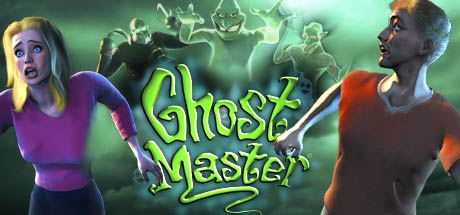
Originally released in 2003 (with special re-releases in 2006 and 2011) Ghost Master is a niche puzzle / strategy game with a small but loyal following. Basically imagine The Sims except instead of controlling the people you control the ghosts who mess with the people. The more afraid of you they are the more powerful your ghosts become and the more they can affect the physical world. You have to decide which ghosts to take with you on new missions, where to place them, and which abilities they should use. Watch out though, if a ghost is located by paranormal investigators or a coven of witches then they will try to banish it from the level. The controls and the graphics are definitely of an older generation, but if you can look past that and relish the idea of scaring the living daylights out of some Sim-like persons then this is right up your alley.

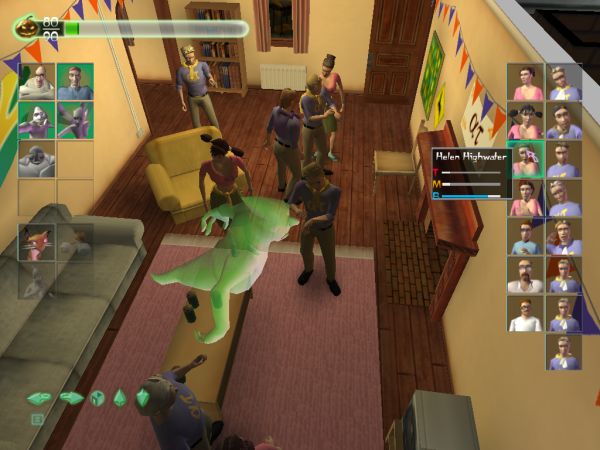
You begin each level with a description of the place you'll be haunting and why your haunting it. The reasons can range from "because we can," to solving a mystery, to stopping certain persons from interfering in the matters of the deceased. You also unlock new ghosts in every level so there's that as well. You get to pick a 'squad' of ghosts, each one with its own unique set of powers and sphere of influence. When you enter the level you'll see a layout similar to The Sims where you can see inside the building(s) one floor at a time with people walking, talking, reading, sleeping, and otherwise moving about their business. You place your squad members at different places throughout the map and then either manually execute their powers or tell them which powers to auto-use. The mortals can't see the ghosts but they can see the affects of their powers (some do make a ghost visible). Each power requires that you have a certain amount of energy stored up which you gain from scaring the mortals. Thankfully using abilities does not drain energy which means that if you have 100e then all of your ghosts can use all of their powers that cost up to 100e indefinitely. Your power (very) slowly decreases to keep your ghosts attached to the physical world but for all except a few levels this will not affect how you play.

A gremlin causes a power surge to zap sorority girls around the TV.
If this happens a few more times they might think that it's possessed...
Your ghosts can only be placed according to their type. Gremlins, for example, can be attached to electronic items and all of their abilities have to do with the item they are attached to. They can make it malfunction, act 'creepily', zap nearby people, etc. A water spirit, by contrast, can be attached to a body of water or a piece of equipment / furniture to do with water and they would have water-like abilities from fog to flood to turning water to blood. A wraith, by another contrast, can only be placed on things associated with death and while its abilities are more fear inspiring than malfunctioning electronics and mysterious fog you won't have as much opportunity to use them without being creative. Creative in this case means luring mortals to where your heavy hitter ghosts can scare them. Strange sights and sounds may make mortals curious to investigate while scary things can make them flee in a certain direction. You can re-locate ghosts to another valid position on the map with ease but for some of the stronger types there may only be one or two spots on the map where they can go. Using ghosts also grants them experience which can be used to unlock further abilities.

A 'spook' ghost can be attached to any room and is by far the most maneuverable ghost. With so many mortals gathered here it would be a perfect time to turn visible or start moving the furniture around.

Each mortal has a number of stats for you to take into consideration. The first is their amount of fear. If it gets high enough the mortal will flee the map. The second is there insanity. If you get it high enough they will go bonkers and run around the map disturbing the other mortals. The third is their belief in ghosts, their susceptibility to being scared. Each mortal also has a secret consciousness fear and subconsciousness fear that can be used to your advantage. If a mortal simply does not believe in ghosts then their otherworldly powers will rationalized as a strange occurrence and you will have a hard time scaring them, although providing enough evidence of the existence of ghosts will increase their belief and start making them susceptible. Chaining scares on a group of mortals that is already scared is a good way to create an avalanche of fear and belief which should give you enough energy to use the higher tier abilities on that level. Exposing a mortal to their conscience and subconscious fears will eventually make them go insane with hilarious results.

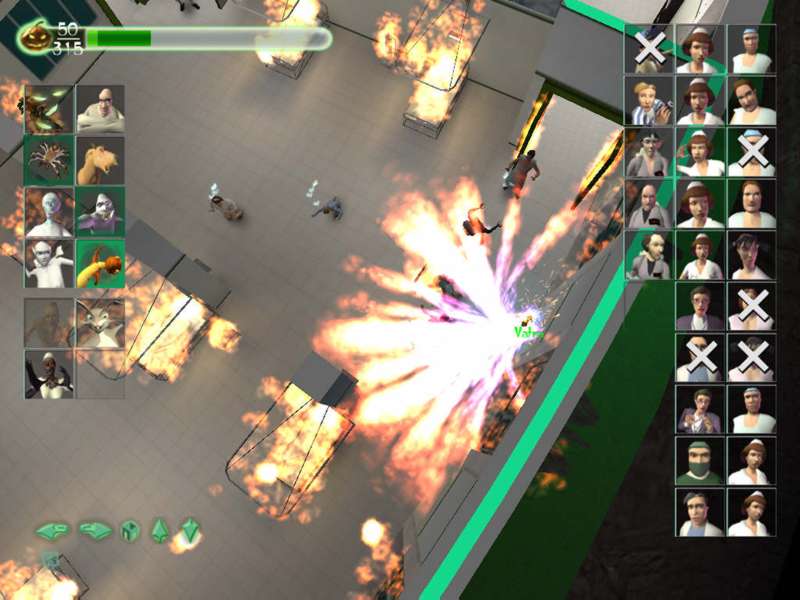
Don't worry it's not real fire... but try telling that to the mortals who are running for their lives!

More than puzzles and strategy this is a game about messing with things and this is where I had the most fun. It may not be quite as efficient to toy with the mortals but it's the only ghost simulator in existence where you get to be the ghosts so who cares!? This is a game where you can zap unsuspecting people, turn the lights off on them, and make them run screaming with a thunderclap! This is a game where your goal is to create chaos and confusion and you have an arsenal of very capable ghosts at your disposal who specialize at doing just that. The setting and the theme are amazing and even though the execution was a bit clunky (still quite good by 2003 standards) I can not for the life of me figure out why this game never caught on and why nobody made a sequel. You get to set people on (illusory) fire and watch panic ensue as spiders and ghosts and hurricane force winds and falling fish (and more) appear out of nowhere... who wouldn't want that? Granted there are some levels where you need to be strategic and not scare the mortals and while most of these levels are very particular about what will and will not work, the game as a whole is sweet candy.

Saturday, August 13, 2016

Greg Recommends The Kerbal Space Program

Price : $40
Store : STEAM

Take a rocket physics simulator and replace humans with little green men and you have The Kerbal Space Program. This is as accurate a rocket simulator that you will find outside of NASA, and while it is awesome it is not for everyone. The physics engine is unforgiving and bad design or incorrect timing can quickly turn into a fiery mess. This game is lots of fun to mess around with, but to actually do well you will have to learn some rocket science, and not everyone wants to do that. For those who do have the interest, patience, and sticktoitiveness this is definitely a game worth playing.

There are three modes you can play in, sandbox which gives you unlimited money and access to all rocket pieces, science mode which gives you unlimited money but restricts rocket pieces according to your research, and campaign mode which lets you earn money by doing missions and restricts rocket pieces the same way as science mode. You're objective is to explore the Kerbal System (Solar System). Why? For Science!

Every time you test out new equipment, land in a new area, or run science tests under new situations you earn science points which you can use to unlock more rocket pieces which will (theoretically) take you further into space to find more science! The game comes with a few 'pre-loaded' rockets and vehicles but the vast majority of what you will be using are things you put together yourself. Even though the first few rockets don't break through the atmosphere it isn't too long before you find yourself in space, high above the surface of Kerban with 0 Gs and lots of science to uncover. Getting that science (and your Kerbalnaughts) back down to Kerban is a bit harder than actually getting it in the first place though. Like I said, this is a realistic physics engine, and things tend to burn up upon re-entering the atmosphere. You'll want to make sure that your re-entry capsule isn't too heavy and that you have heat deflectors to keep the vital (and sciency) parts from getting damaged. You'll also want to make sure that you pack enough parachutes and that your angle of entry burns up enough velocity that said parachutes don't just rip off when they need to be deployed. I consider myself moderately competent at this game and my Kerbals still tend to die a lot in horrible horrible ways. Thankfully there's a reset button on the less punishing difficulties which allows you to start a given rocket flight over again from the beginning.

As you can imagine the game has a steep learning curve. The tutorials, while indeed useful and informative, don't hold you hand either. This game requires skill and patience to learn. But this is part of the fun, not just learning actual rocket science but also getting an incredible sense of accomplishment when you finally make a stable orbit or safely land on the Mun or any other celestial body and breathe a long sigh of relief when your intrepid Kerbalnaughts safely return back to Kerban with all their science. This game makes you work for your achievements, every launch, orbit, and landing is a potential nail biting experience, especially if something goes wrong or you're not sure if you have enough fuel to make it home...

Jebedia Kerman probably wishes the architects had gone with 4 landing legs instead of 3...
It will be at least 2 years before a rescue craft finds him on the surface of Duna.
Something you'll need to get used to very quickly is how to use your instruments. 'Eyeballing' your directions can be fun to do when your messing around but if you actually want to achieve orbit or land on the Mun then using your instruments is critical. The one I use the most is the spherical direction ball which has markings already in place for which direction you need to go to increase, decrease, or 'move' your obit as well as which direction to go to move towards or away from a marked heading. If you use these to guide you then you stand a much greater chance of success. If you don't then you will most certainly fail.

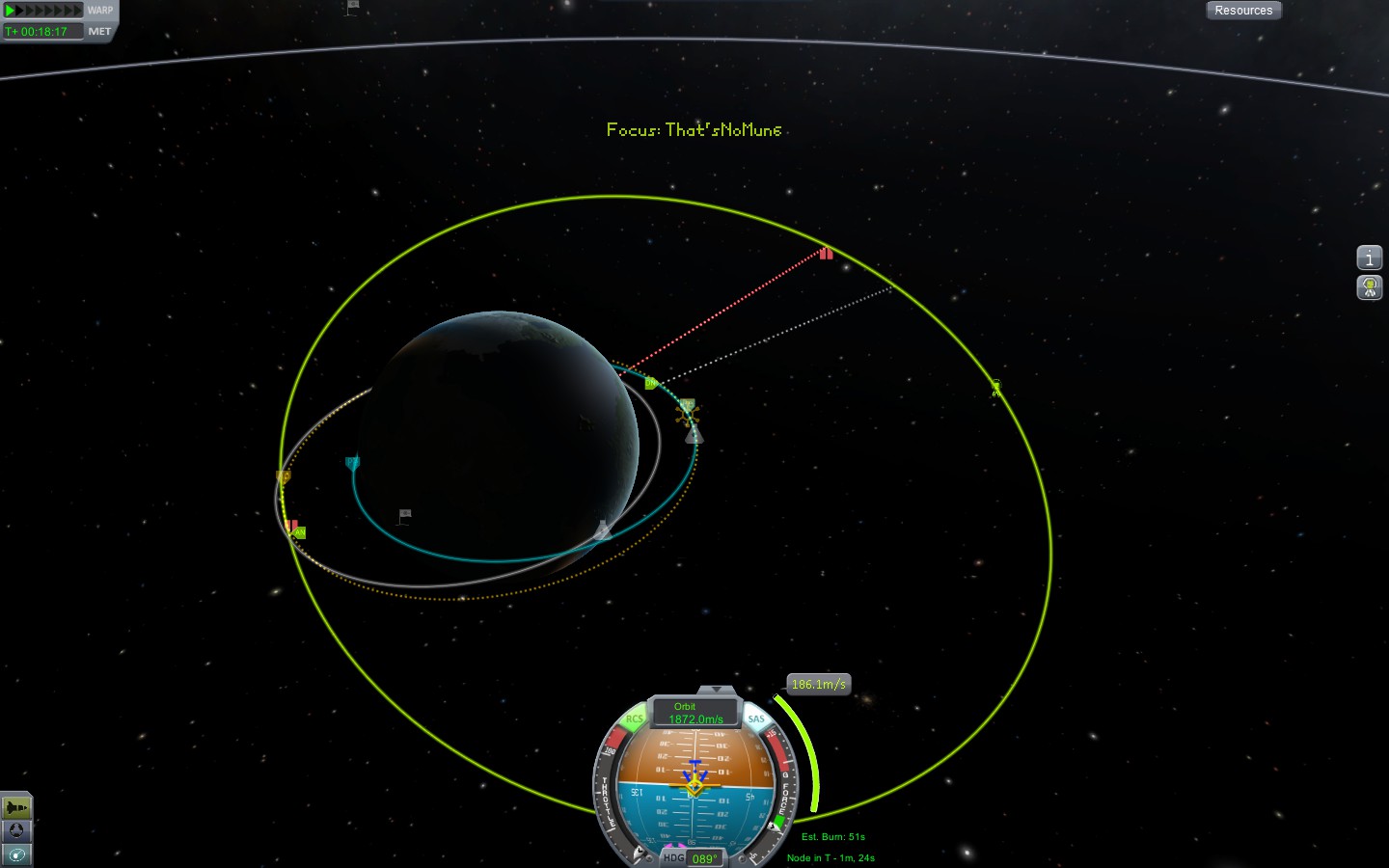
The other instrument that I use constantly is the nav computer which shows you where you are in relation to, well, everything, and what your orbit will be if you remain at your current velocity. This is especially helpful to gain a stable orbit around Kerban so you don't dip back into the atmosphere and even more important for when you want to travel to another celestial body. Since orbits are defined by the gravitational force of a planet, moon, or sun you are essentially expanding your orbit around Kerban to the point where where you will be at the height of your orbit is where the Mun will be so that you can enter into its gravitational field and adjust your velocity in relation to it instead of Kerban (doing this is what finally made Einstein's theory of relativity make sense to me). This is hard to communicate if you've never played the game before but you're essentially hopping out of one gravitational field into another. Thankfully the game lets you manually 'set a course' in the nav computer which creates an image of what your orbit would look like if that course was followed and an estimated time you would need to burn your thrusters to achieve said course. This is the rocket science I was talking about earlier.


Every rocket, space plane, and buggy can be created from scratch using the rather intuitive and fully customizable options of the rocket hanger. Pieces can be snapped or slid into place, rotated in 3 dimensions, or mirrored to be placed at equidistant intervals around another piece. You'll want to construct your spacecrafts in stages so that fuel tanks and engines can be jettisoned once they run out of fuel so as to not weigh you down and that parachutes can be deployed if you are planning on a return trip. You can create as many stages as you like using as many pieces as you like (once you unlock the final hanger upgrade) but the best rockets are (understandably) streamlined with multiple takeoff boosters arranged in 'asparagus formation' where all the engines draw from only two tanks at a time so that they can be jettisoned quickly and reduce weight evenly and most efficiently. (Once again, kind of difficult to describe if you haven't played the game).

You can also construct 'space planes' and shuttles that can fly with or without atmosphere, but I have not had very good luck with these for some reason and you need to spend lots of science to make them a feasible replacement for rockets.

For extra dangerous missions, or for missions where you can not make a return trip you can use a remote control system powered by batteries. This is where solar panels come into play, to keep unmanned explorers and satellites running. You don't get as much science broadcasting your findings back to Kerban as making a safe return, but the difference will be made up should you ever repeat the experiment / discovery and make the return trip some time in the future.


You can also 'build' space stations with crew quarters, science generating laboratories, and docking ports for space-faring vessels to latch on. I put 'build' in quotations because you will need to launch each piece into space and dock them together manually which is, without a doubt, the most difficult and patience wracking maneuver you can pull off in this game. Matching another object's orbit requires careful and precise piloting, but lining up to a docking port and actually making the connection in 0 Gs is an incredible feat. I will take this opportunity to boast that I have done it a few times.

For anyone looking for a realistic space exploration simulator this is as real as you will ever find for $40. For anyone else who is remotely interested in flying rockets to the moon this game will teach you so much about how actual rocketry works and you will (hopefully) have a blast while learning. What really makes this game for me is the challenge and the mechanics. In other space adventure games traveling to another planet is mindlessly easy (No Man's Sky) but in The Kerbal Space Program traveling to another planet is the game itself, you have to get there and get back in one piece and its hard, but doable. Once you make your first successful mission to the Mun you will feel like you've conquered the world and accomplished something impressive. The Mun is just the start though, there is a whole solar system ready to explore... for science!


Friday, August 12, 2016

Greg Avoids No Man's Sky


Earlier this week the highly anticipated 'No Man's Sky' was released. I followed this game in development, a few reviews have popped up from gamers and critics, and I think I have enough information to recommend that people avoid this game. It feels strange recommending that people avoid a game that I have never personally played, but listen to my argument and decide for yourself.

No Man's Sky is a mind mindbogglingly enormous survival space exploration game. Trillions of procedurally generated planets, each one unique with its own plants, animals, rock formations, and ruins. You, a single wanderer with a spaceship in an unfathomably huge galaxy with your goal to get to the centre. Here's my issue: the game is a gazillion miles wide but only an inch deep. Under the vast and colorful sci-fi aesthetics there are only very simple and rather annoying mechanics.

So what do you do in No Man's Sky? You start out having crash landed on a strange planet and you need to locate and harvest the necessary elements to repair your ship and keep yourself alive. The planet is big (of course) and colorful and full of plants and animals and rocks that can be scanned to reveal what sort of elements the contain, and harvested. None of the elements are very difficult to find and every planet seems to have plenty of each. You can also scan and record the exotic fauna and flora to earn credits which can be used to purchase new tools, weapons, and ships. You can also find ruins that will teach you an alien word so that when you run into aliens you can piece together what they are saying to you. Once you repair your ship you can travel to other planets which you will need to do often as your life support / weapons / thrusters / tools will require constant refills to keep you going.

But here's the thing, all of the worlds you travel to are procedurally generated. They are all 'unique' but there are also, underwhelmingly, exactly the same. Sure they will have different amounts and types of fauna and flora but after playing a few hours you will have seen and experienced all that you will ever see and experience. One planet is just like the next, a place to visit, to walk around, scan, harvest, and leave. There is no story, no adventure, no impact, your actions mean nothing, and whatever tiny mark you make will never be seen again. It's the same elements, the same ruins, and the same alien structures with the same aliens selling the same things. You can upgrade your inventory / ship / tools / components to be more efficient and let you go through the game faster.

The combat is very simple and barely worth noting.

What I see in No Man's Sky is a technological breakthrough with being able to travel an entire galaxy of procedurally generated planets without any loading time whatsoever. This is an impressive feat that will not go overlooked by anyone. I don't think they made a game worth playing with this new technology though. There's just no point to it. Sure, exploration can be a fun and exciting thing in and of itself but never procedurally generated exploration and never when traveling to planets is so incredibly quick and easy. Once you see the selection of possible ruins and structures you will have seen them all. Every planet in No Man's Sky is just a more visually pleasing planet from SPORE, a pretty but vapid place to waste time. The only interesting things worth doing are seeking out new plants and animals (which will also become samey just not quite as fast) and making your way to the centre of the galaxy for whatever procedurally generated thing waits for you there but are these things actually worth doing and is doing them worth $79.99 and dozens of hours of your time?


If you have a first person space exploration itch that needs scratching go take a look at the X3 series or The Kerbal Space Program; these are quality titles with more value and at a lower cost.

At the very least read more reviews to make sure this is what you want to spend your money on and maybe wait for the price to go down.