Startopia was a phenomenal game for its time (2001) and aside from some initial hiccups at setup it is still a really good game fifteen years later! It was created by the same folks who gave us Populous 3 and Dungeon Keeper 2 so be prepared for innovation, quality, and quirkiness in this classic space station / amusement park / gardening management sim.
 |
| Not bad for 2001 graphics. |
Startopia puts you in the unique position of a space station administrator tasked with turning a derelict space station into a profitable hub of business and pleasure. You are provided with basic structures, some scuzzer bots, and a sum of energy (money) to get started and it's off to the races! Your first goal will be to attract aliens to land at your portion of the station and get them to pay you for things that they need or want. In the beginning of the game this usually means offering basic food, sanitation, lodging, health, and maybe a love nest or some simple shops. The more services and higher quality of those services, the more aliens will land and if they leave happy the higher your popularity will be. As you start to earn a profit you can look at investing in a variety of options to gain the advantage over your rivals ranging from factories to disco/rave pits to communication relays to spiritual retreat centers to advanced medical care and beyond. The more you grow the more options you unlock and the more things that could go wrong. The progression isn't perfect, but it is fun.
 |
The outside of your space station. The glass enclosures are sections of the biodeck,
below is the pleasure deck and at the bottom is the utilities deck. |
The map in Startopia is unique in that it is a spinning doughnut shaped space station partitioned 'horizontally' into 3 decks. The lower utility deck is where all the industry occurs, the middle 'pleasure deck' is where your guests can shop, have fun, and enjoy luxury living while the upper 'bio deck' is sculpted to resemble a 'Halo type' planet surface for aliens to 'get some fresh air' and enjoy reconnecting with nature. The space station is further partitioned 'vertically' by enormous blast doors that can be unlocked once you pay the required amount of energy to repair the adjoining section.
The style of map is sci-fi genius, tactically unique and interesting (as much as it needs to be for this game). There is only so much room on the space station and you will eventually grow to the point where you are rubbing shoulders with your rivals. More on this later. What might throw new players is that gravity pushes everything to the outer edge of the doughnut structure of the map and so once you unlock enough sections you realize that everything appears to be moving uphill in both directions and that aliens (and buildings) far away from the camera look like they could tumble down the slope.
 |
| The Utilities Deck |
The first bit of fun is figuring the system out for the first time through the guided campaign. You're AI assistant 'VAL' (a sarcastic parody on Space Odyssey's 'HAL') leads you through nine scenarios each of which focus on a specific aspect of the game. In the first level you learn the basics. Some buildings come as is and you just place them on the ground. Other buildings require you to set a floor plan and then decide which other pieces to include and where to put them inside the building. If the buildings / furniture placed were in your inventory then scuzzer droids will grab the crates (because everything gets packed into crates) and unpack them. If they were not in your inventory then you use energy to make them materialize which is convenient but expensive. Aliens need food, sanitation, sleep, health, social, and fun. The first alien types (Gruelian Salthogs, Grays, and Grekka Targ) are fairly simple and tend to get along with cheaper accommodations even if their tastes differ on a few points. Soon you'll have a handful of aliens aboard paying you energy credits for meals, beds, and basic shops and you will feel like a benevolent disembodied observer looking upon the works of your hands.
The second bit of fun is finding ways to advance beyond your humble beginnings. The campaign does a good job of introducing new concepts and new ways of advancing such as producing your own buildings / furniture / droids with factories, or trading with different species, or growing plants to harvest on the boi-deck, or research, each with its own pros and cons. Manufacturing goods is cheaper than materializing them but it takes longer, and you can only manufacture goods that you know how to make. Researching new buildings and products takes a lot of time and setting up research facilities can be very expensive while simply purchasing a needed item from a trader, even at a high price, may be a lot better in the short term. You have to decide how to proceed and which aliens to hire onto your staff as each alien type provides a different function and each specific alien has its own stats to consider (competence, loyalty, and dedication). Unlocking new buildings and items to attract more aliens and make your station look awesome or become more efficient will net you a larger income and hopefully an edge over the competition.
 |
| Lots of aliens enjoy the bio deck. |
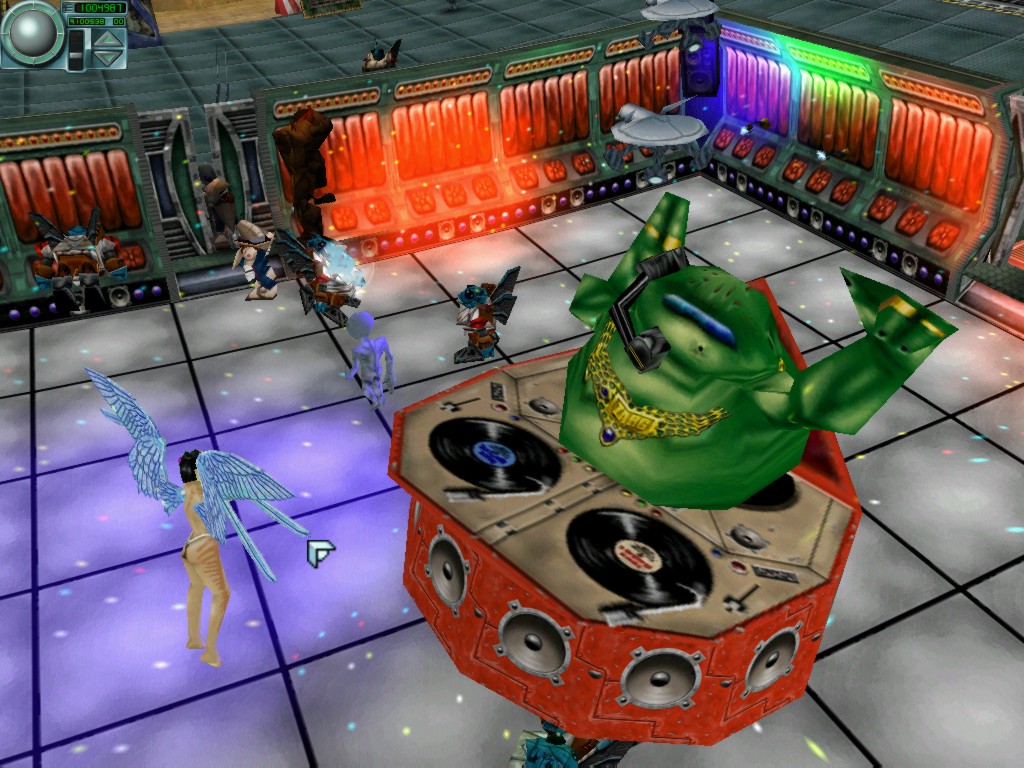
The third, and largest bit of fun (in my humble opinion), is just watching everything. The developers put love and care into the visuals and it is fun to just watch everything happen. Aliens going this way and that way, talking, working, dancing. lounging. Scuzzer bots zooming this way and that to clean or repair or recharge or move crates. The graphics are amazing for 2001 polygon technology and placing plants and decorations strategically still makes the game look pretty good even by today's standards. The bio-deck is fully customizable allowing you to adjust elevation, water level, heat, and humidity. The game also rewards you for watching closely as you can earn extra credits by manually warping trash into a recycler and you can catch non-staff aliens fraudulently using facilities or terrorist aliens planting bombs and so alert your security staff accordingly before they do too much damage. (you can build security systems to flag and arrest or kill hostiles so you don't *always* have to be on the lookout.)
The fourth bit of fun is the intrinsic humor infused into this game. Your in-game assistant and campaign narrator is a sarcastic dry-wit AI who is full of advice that draws on stereotypes, pop references, and enjoys humorously insulting and complimenting you often doing both at the same time. The game is full of little touches that give it humorous style, from the campy looking terrorist space man conspicuously 'sneaking' to the scuzzer bot charging stations that comically flip robots upside down to screw a loose bolt into their bottoms, to the dubious trader "Arona" finding various ways to try convincing you to buy his overpriced (and quite possibly stolen) goods. Their is also the way aliens have their 'love' desire met, by going to a 'Love Nest', standing before a 'Siren' type alien, and allowing him / her to shower glowy lights and hearts down upon them. Don't worry, alien love is very child friendly, rated 'E' for everyone.
 |
| The Pleasure Deck |
Eventually your little money making paradise in space will run into an opponent (assuming that you're playing with AI or a friend). The station is only so big and it is only a matter of time before you unlock a section adjacent to another administrator. Assuming the competition doesn't go bankrupt due to your ruthless efficiency at providing better services at less cost to yourself you can look forward to some firefights that will leave buildings in fiery ruins and send non-combatants running for their lives. If you can get a security scuzzer bot to the other side of an opponent's section of the station it can hack the blast doors and cut the section off from your opponent and rewiring which energy source it runs on thus making it officially yours and allowing you to build there unless your opponent takes it back. The combat mechanics are not very interesting, but they serve well enough for a non-combat game. Basically just hire all of the big beefy combat loving aliens you can, order a scuzzer bot to hack the controls in enemy territory, and start flagging which enemies you want your mob of laser shooting aliens to target first. Once you take out all of your competitions' energy collectors they are knocked out of the game.
 |
| A rogue Grey has been caught using medical equipment at your expense. He is being escorted off the station. |
There is little strategy involved in combat and it is probably the least fun element of the game. All of the strategy in the game is in netting a higher income, reducing your costs, and making things more efficient. Buying low and selling high with trade ships, realizing that you can make an extra 50e per medical examination if you can pick up medical supplies cheap from the Grey traders, or even better, grow them yourself in the bio-bay. It's using research to unlock strategic technologies so that you can build things yourself instead of playing a game of chance with which trader will show up next and then paying through the nose to get what you need once it finally becomes available for purchase. It's building a tourist trap so attractive and so luxurious that the filthy rich Gem Slug race not only come to spend money but also stay long enough to leave valuable "turdite" on the floor which offers a high energy return rate with the recycler. It's making an efficient security system that can detect saboteurs before things blow up and arrest criminals before they start pretending to be staff and start costing you money (you can also make money by rehabilitating said criminals). Under the sci-fi cutesy ant-colony exterior (which is a good exterior, make no mistake) it's all about efficiency.
Startopia is fun but it's not perfect. The management tools aren't very maneuverable, the diplomacy settings are confusing, and navigating the staff bar becomes time consuming and unwieldy by the end of the game. There is no opportunity for interaction of any type between players except for sending your mob of laser gun wielding staff to do 'aggressive negotiations'. The game isn't very challenging once you know what you're doing, and events like plague ships, asteroid showers, or space beetle invasions are interesting the first few times they happen, but ultimately do little to shake up the underlying efficiency game. I also feel that there could have been a lot of potential for more 'extra' aesthetic items as well as fostering negative reactions among differing alien species beyond just a sad or angry face. But hey, the game was made back in the distance digital the bronze age of 2001 by a small team, so I can forgive Startopia for not being perfect.
What it does do well is simulation and atmosphere. The various game systems (trade, manufacturing, research, medical, hiring staff, alien needs / wants, etc) blend together very well and the graphics are as good as early 2000's graphics get. Part Deep Space 9, part Rollercoaster Tycoon, part Tropico, and part monopoly the game is full of heart and a must for gamers who can appreciate gentle paced sci-fi or management games in general, or even just games where you get to peacefully build cool things.